17th January, 2017
Apologies as ever for the late post, but it has been busy here in Mandalay and I have taken so many photos that they need a fair amount of time to sort out and then upload into the blog. Hopefully I will get some way to catching up, but there is SO much to tell you!
Our first day proper in Mandalay started, of course, with breakfast (very good) and we were ready and waiting for a 9.00am start with Nee, our guide (I am still working on the spelling, but still pronounced Noay) and Soe, our driver, picking us up at the hotel as we started our short drive south to our first stop in a town 11 kms away called Amarapura. A quick word about capital cities before I go any further. It was the practice in the past to move the capital to a new location, especially if the King’s astrologer advised him so to do. Amarapura suffered this fate twice but there is much still there to see and our first port of call was a monastery, called Maya Gandayon Kyaung.
Nee is a fount of knowledge, especially on anything to do with Buddhism, which is really helpful as it is such a vital part of Myanmar culture and life. The monastery we visited is a conservative one where the monks are permanent residents, rather than the case where you do a short stint as a monk like a sort of National Service. It was fascinating not least when everyone lined up for their lunch. The system is that a donor family will provide the food for the day. I should point out that lunch is the last meal of the day! It did feel a bit intrusive, as though it was feeding time at the zoo, but a wonderful insight into a part of the life here.


The plaques list past donors and the gentleman in the room is a statue of the founder of the monastery, who died not long ago. The monks in white are novices. As you can probably tell, they can start quite young! Nee very kindly arranged for us to have a chat with a monk of some years standing who spoke excellent English and was happy to answer any questions on Buddhism or indeed anything you liked. Really interesting and we could easily have chatted for hours. Very thought provoking…….
It was off though to view some silk and cotton weaving next. Beautiful, delicate work, mostly of the ubiquitous longjis (I have changed the westernised spelling a bit to make it sound like the pronunciation), which are the sarongs worn by almost all men and women in Myanmar. An excellent shopping opportunity too.


Next on our busy schedule was a visit to a monastery school which was also part orphanage. It is only in the last few years that education has been freely provided by the state and the monasteries were important institutions for this. If ever children in England complain about school rules regarding uniform and hair styles they had better not come here. Pink robes and shaven heads or the burgundy colour of the monks! What seemed universal, though is that the boys played football (one in an Arsenal shirt!) and the girls chatted – just like back home. Mind you, there was a good crowd watching something on the TV. Nee bought some sweets for Val to hand out, as is the custom and they formed a very orderly queue for the vicarious largesse of Mother Val! Note the teacher/pupil ratio!


And off we went again (I hope you are getting the picture as to why this blog has been some time coming – but oddly there was no sense of rush during the day, which was taken at a very nice pace). We set off for Sagaing, which, guess what, is a former royal capital! Mind you, only for 4 years. It is probably most famous for its hill, a stupa covered hilltop with good views of the surrounding countryside. We managed just the one stupa, the Sone Oo Pone Nya Shin Paya (paya is the loacal word for pagoda) plus a visit to another religious structure on the hill, Umin Thounzeh, a curved chamber containing 43 seated and 2 standing Buddha images.


I particularly liked the picture of the four young monks with their mobile phones! And if you are wondering what Nee is up to, she very kindly demonstrated how to make thanaka, which is a paste that is made from ground tree bark mixed with water and applied to the face, often in spectacular patterns. It acts as a sunscreen, perfume, decoration and skincare product all in one and is extensively used by men and women throughout the country. It seems a bit odd initially! A couple of example below…


It was now time for lunch, but first we had to get there, which involved a short ferry trip to Inwa, formerly known as Ava and a former capital on no fewer than 4 occasions! Lunch was excellent in a lovely outdoor restaurant.


It was now time to board our third form of transportation for the day, our horse and cart. This is de rigeur here and whilst a bit bumpy and dusty (especially after lunch) was a relief after the fumes of the motorbikes and a chance to step back in time.


There is some rather tranquil countryside to see too, with rice paddy fields and ibises and cattle here and there, with a stupa appearing at regular intervals. We were heading for a temple with a difference though as it is entirely made of teak. This is Bagaya Kyaung, built in 1834 and it still has a small school in it with a monk teaching there. He was sitting so still that Val thought he was another waxwork and Nee had to ask him something to prove he was real!


We dropped in on another, rather different temple, whose name escapes me, but which looked particularly lovely in the late afternoon sun. And apparently no visit to Inwa would be complete without a drive past Nanmyint, the ‘Leaning Tower of Inwa’, which ended up that way after an earthquake in 1838.


We were not yet finished though and our last stop at Inwa was the Maha Aungmye Bonzan temple, which is beautiful if rather falling apart.


Ok, as you can tell from the shadows in the last set of photos, we were nearing the end of the day, but Nee had kept possibly the best for last (though it is very hard to choose on such a spectacular-filled day). This is the U Bein bridge. This is made from teak and stretches more than 1.2 kms across Lake Taungthaman and is the world’s longest teak footbridge. It was built by the mayor of Amarapura, U (Mr, but for older, more respected men, as in U Thant, for my older, more respected readers who may recall the Secretary General of the UN) Bein from the remains of the royal palace when the capital moved from Amarapura in 1859. If it looks a bit high, that is because the water is low! It can cover it in the rainy season ! Very, very photogenic and I have spared you a shed load of photos!


A long, but VERY satisfying and enjoyable day. It only remained for us to walk to a local restaurant for supper. We had been warned not to order side dishes as they are generous with the portions, but it was still a feast and, even with a beer, cost a massive £7.50!
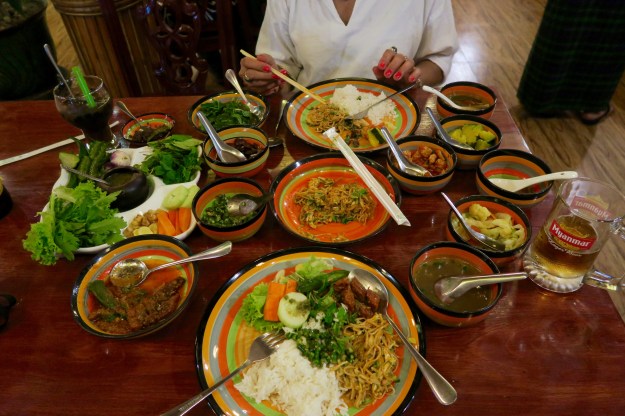
And the picture does not include a complementary dessert!
Well, definitely time to post this. I have to get started on yesterday’s outing!
Till then……
 John & Val's World Travels
Happy birthday again John. You are clearly going to have a fantastic day ! Am reading your blog sitting on the cold cold bus at about 7.30 am (–1) on my way to work. I trust you are both feeling very smug. Looking forward to getting back this evening to seeing the photos on the computer. It all looks fascinating. Lots of love. Lala
LikeLike
Clicking on one of the photos, I think I have hit the motherload! Wonderful!! L
LikeLike