Author Archives: jfbemanuelorguk

A Day on Inle Lake

24th January, 2017

As ever, I am playing catch-up, so I am going to make this as quick as I can and, as ever, let the photos do some of the talking (being worth a thousand words each after all!).

A lovely morning greeted us with a mist hanging over the lake as the sun came up from behind the mountains. There was even a balloon and some wildfowl to snap. A good breakfast, a quick pose with some of the staff in some very spectacular costumes and it was off in our trusty boat for a very full day of visits around the lake. It was a bit chilly as the lake is over 3000 feet up and it is, technically winter here as in the rest of the northern hemisphere. Val was feeling the cold, but rugs are provided on the boat, so all was well, not least as I was in the forward seat and could act as a windbreak.

Before we reached our first appointment, we were treated to some beautiful birds and the famous Inle Lake fisherman who operate their boats by paddling using one leg and a foot, which leaves their hands free to organise the net. Very photogenic and scenic and really rather unique. I would have fallen in very quickly.

First port of call (literally) was the local market, which at Inle is not as simple as it may seem as the markets move around the lake on a five day cycle. The scene that greeted us was astounding. First of all you have to find a spot to park the boat, politely refusing the offers of goods from enterprising sellers who row out to meet you. It was then time to walk round the actual market that sells everything from souvenirs for the tourists to fish, meat, fruit, vegetables, cooked food and large bits of bamboo that are used to ensure your floating garden doesn’t float away. Very local as can be seen by the headdresses and other costumes and also in the look of the people themselves. First our arrival and general market scenes.

However, as you may have gathered from my previous posts, it is the people who are the main attractions for me and they certainly didn’t disappoint. I could easily have stayed there all day. I have really, really tried to limit the number below. You should have seen the ones that got away.

And then there are a few pictures that simply didn’t fit into any other categories.

Ok market done. We set off again, this time for a number of local industries, starting with weaving using silk, cotton and lotus stems. Beautiful (and sadly expensive) work using some wonderfully old machinery as well as a new use for bicycles.

Next it was the cheroot making factory, yes, cheroot making. A bit of a surprise, but a popular smoke in these parts. Each person making the cheroots adds their own unique flavour to the ones they roll, but I was not sure how, exactly. We passed a few interesting buildings on stilts too.

No time to waste though as there was the boat-building yards, complete with the massive barge that is used for transporting some very special Buddha images each year at festival time round the lake. We got to see these statues in a local temple, but it was no longer easy to see how they were images of Buddha due to the astonishing amount of gold leaf applied over the years, so that they now look like golden cob loaves. We also dropped in on a silversmiths too.

We were still not finished and there was another interesting temple to visit that had quite a number of ruined stupa, many of which were being restored. The temple itself is reached via an 800 metre arcade, usually lined with souvenir stalls, though many had closed for the day by the time we arrived. There was a positive forrest of stupas at the top.

And, of course there were some local characters who hove into camera shot, both on land and back on the water…

Two last stops before the dash back to the hotel. First a visit to a group of long-necked tribes women who had settled near the lake. I have to confess I felt uncomfortable seeing them and photographing them, even though they were quite happy for us to do so. It did smack rather of a freak show of old. Sadly I really don’t have time to explain what they were all about, but they were very cheery and thought their situation was perfectly normal.

And finally, Thwin took us to view the floating gardens (of the market variety), which cover a vast part of the lake and where are grown large crops of tomatoes, beans and other crops as well as flowers. As far as I could gather, they are floating on water hyacinths held in place by bamboo poles. Thwin kindly demonstrated how bouncy they are. Oddly I was not allowed to set foot on them!

And that was very nearly that as the sun sank while we made our noisy way across the lake to our hotel. Val ended the day as she started, under a blanket. I was just happy to be able to capture another sunset!

It did look a little as if our hotel was on fire, but it was just some burning going on to acquire ash for mixing with something I have completely forgotten. A fabulous day at a fabulous place.


Inle Lake – A touch of Paradise

23rd January, 2017

Another fairly early start for another short flight, this time to the town and airport of Heho (yes, lovely name, isn’t it) in Shan State, southeast Myanmar, which is the place to go if you wish to visit Inle Lake. Our new guide was the delightful Thwin, who advised us that we would be making a detour first before setting off for the lake to Pindaya, a typical Shan State town set around the small Pone Taloke lake. The road there was about one and a half carriageways, which meant that you slipped off the side a bit for oncoming traffic, but there were a lot of roadworks indicating the rapid development that is going on here. All being done largely by hand and female hands at that.

The main reason for coming to Pindaya is to visit the Shwe Oo Min Cave. The story goes that some local princesses were trapped in the cave by a giant spider, but were rescued, of course, by a handsome prince, who was a noted archer and shot the spider with a single arrow, but not before he had bargained to have the hand in marriage of the youngest princess, presumably volunteered by her older siblings! Note the photo of the moment of confrontation between prince and spider.

The cave is reached either by a stiff walk up the walkway (no doubt good for the soul) or you can take a lift! Whichever method you choose, it is well worth it as the cave or really caves are stuffed full of Buddhas, allegedly over 9,000. It is truly jaw dropping with most of the Buddhas being golden, though with a sample of marble and jade and wood as well. Apparently it started with a king putting a stupa there and then everyone wanted to get their Buddha image near that one and so on. They have stopped any more being added, though they are opening another cave and there is a two year waiting list! I will let the photos do the talking from here on. First of all the legend of the princesses, the spider and the prince, the view and the the entrance to the cave, which takes your breath away….

You then make your way in deeper into the cave and are surrounded by Buddhas as well as a few other objects (not sure what they mean)…..

The furthest part of the cave is a little less congested and you can get more of a feel of the structure of the cave itself. They even have a sign saying maze! It is hard to take it all in…….

All in all, a great way to start our visit to Shan State and Inle Lake. The trees in the town were spectacular, so warranted a photo, I felt. It was then time for some lunch and a quick snap of some sort of grasshopper, which was not, I emphasise, our midday snack. It does though look from Val’s expression that maybe it was!

Next stop was a fascinating visit to a very small paper-making workshop, all very much organic and hand made where they use the paper for wall paper, umbrellas and various other items. Amazing skills – I feel very inadequate!

After a drive of about an hour through some fertile looking farmland, we arrived at the town of Nyaungshwe at the north of Inle Lake to board our trusty long-tailed boat for our transfer to our hotel which was in the top east side. First part was through waterways and canals and then we reached the lake proper. The place is buzzing with life with fishermen and boats and birds and floating islands and water hyacinth everywhere. And yet there is a real peacefulness and tranquility once you are on the lake, even if it is sometimes shattered by the sound of an unsilenced and smoke belching boat engine! We made it ok to our hotel – and what a hotel! The Myanmar Treasure Resort, by the way if ever you get here.

What a way to arrive and what a welcome. Really nice staff as in all of Myanmar, who seem genuinely pleased and eager to help and are always smiling. It is so refreshing. Lovely room where you can see both the lake (for the sunset) and the mountains (for the sunrise) – and it had an outside shower! Mind you, they do like their beds hard in this country, but a very small inconvenience!

And of course we were so overcome we had to nip along for the happy one and a half hours and a few cocktails and to pose with a couple of the girls in their local costumes.

However the real show was only just about to begin – the beautiful sunset, complete with our own fisherman displaying the unique way of fishing here at Inle which consists of using one leg and foot to paddle the boat, the other to balance as you lower a conical net. Enjoy. I have tried not to put too many photos in, but……..

What a great day – and there was to be more adventure the next day!

More soon…..


The End of the Baganning

22nd January, 2017

Our last full day in Bagan and it looked like we were not going to leave before we were experts on all things temples, stupas and a smattering of Buddhism. Maung did a wonderful job of varying our day, but first up was the Dhammayazika Pagoda, notable for its pentagonal layout almost unique in Bagan and certainly unique in the Buddhist world.

Next we went to a local village, Minnanthu and managed to get a bit of an insight into what it was like to live and work there. It was well organised with a school and health station and a good collective approach to getting things done. There was also a small lacquerware workshop and some very  sweet goats.

Next up we visited another temple  called Payathonzu Paya, which is unusual in that it has three identical shrines in a row each containing a Buddha image connected by a corridor.

And then it was off to a monastery, though one which apparently was a mix of existing monks (though we only saw one) and some underground cave-like rooms that were where the monks would go for meditation in the old days.

Lunch next at a very nice riverside restaurant. We even got visited by a lizard!

There was still time to fit a few last temples in. The first one had 4 huge Buddhas wedged into a tiny space. The lying down Buddha was very fine and it was interesting to see earlier Hindu wall carvings. Apologies for the lack of detail, but one, I may be a bit confused as to which is which, two, we were a little bit overwhelmed by the number of temples and three, I need to catch up with this blog!

Val was told that there was a Hindu temple not far away, but sadly it was closed for repairs, which was a pity. There were some other temples in the vicinity that were very pleasing on the eye.

Last stop was the lacquerware factory where the whole process was explained and a tour of the workshop provided – with a visit to the lovely shop thrown in, of course. We could not resist this time, though the prices were surprisingly challenging.

Our days in Bagan were over, but not before we returned to our room to,find this on our bed…

Really sweet and very much a reflection of the kind of helpful, happy staff you get in this country. We liked Bagan. It had more of a countryside feel to it and it was like being in an archaeological park. The time we had there was probably enough, though if you wanted to you could really get into the detail and spend a lifetime of study there.

Off to Inle (pronounced Inlay) Lake next.

Bagan Day 2 – Absolutely Stupafying!

21st January, 2017

Well, despite the title (witty, eh?) we did not visit any stupas to start with, but instead visited the market, which was fantastic. Wonderful colours and busy, bustling people (mostly women – the men apparently were in the tea house sorting out the world) and a fascinating array of produce most of which looked very fresh and inviting. It was very much a market for the locals and Meung, our guide, was invaluable in explain what was what, not least as we had never seen some of the produce and weren’t sure what you were meant to do with it. I make no apologies for the number of photos as I have spared you a load of them and would have been happy to have spent most of the day there, it was that vibrant.

It was also a great opportunity to view the local populace albeit mostly the female half – see comment re tea houses above. The Burmese/Myanmarese are a lovely people, small and petite for the most part and, since they are usually smiling, exude a very welcoming air. You do not hear many raised voices except maybe for a shouted joke across the market. I feel like a large, rather fat and ugly giant by comparison.

One last photo from the market is of betel leaves, fairly widely used with lime and tobacco (I think) and it is largely chewed. As we know from Papua New Guinea days, it can give a hallucinogenic kick but also mouth cancer and ruin your teeth. Mind you, they display it beautifully!

img_2202

We said goodbye to the market, but Meung had an interesting tour for us today as our next destination was a local soya bean factory. We walked through the local village first and down to the blanks of the Ayeyarwady River, getting a brief insight into local life in the countryside with livestock (we liked the end-to-end pigs) and vegetable gardens scattered about.

From there it was a short walk to the soya bean factory, a village industry that seemed to be thriving and even exporting to other countries. I like factories and all the processes and, as ever, Meung had all the facts and explained how the whole village would take part. I think they even hired extra workers.

It was then time to get back to the temples (only about 2,196 to go), so off we went to our first of the day, Htilominlo Paya, an impressive double cube with some fine stucco work and four large Buddhas inside.

A short drive took us to another ‘leaning tower’, indeed two of them and some other striking stupas that were not even worth a mention in the guide book, but which would have been top notch anywhere else. I felt sorry for them so took their picture. Note the weaver bird nests.

Next was Ananda Paya, often considered to be the most beautiful of the temples and pagodas. What is most interesting is that it has been restored having been cleaned and the plasterwork brought back to its former glory. This gives you an idea of what all the temples would have looked like in their prime as the brick remains that you see everywhere were only the base for a covering of plaster. It was completed in 1090 with a spire that rises 52 metres high (which gives you a foundation for imagining how tall the pagoda at Mingun would have been at 150 metres high!). Note that the wide angle lens I have tends to flatten things….

And that was that for the day. As you will note from the date of posting this, I am a long way behind, so I have had to leave out a lot of detail about the buildings and sites we visited, so you will just have to visit them yourselves. I hope you are lucky enough to do so. Till tomorrow……..

The Beginning of Bagan…..

20th January, 2017

Our time in Mandalay came to an end rather early as we needed to check in for our flight to Bagan at 0800, which meant leaving the hotel at 0700ish as it is a surprisingly long way to the airport. All went well and we were soon aboard our propeller  propelled plane for the half hour jump southwest to Bagan. It was odd being on board a plane with propellers – haven’t done that since PNG. They seem to work ok though sitting right next to one of them was a smidgen unsettling. Nice views of the brown countryside interlaced with fields marked out by trees. It was not all that different to England after a really, really dry summer.

We arrived safely and were met by our new guide, Meung and our driver, Mr Chee, both of whom are, as one comes to expect in this country, delightful. Mr Chee is a trifle taciturn, which is fine, as he can concentrate on the driving, whilst Meung is a fount of knowledge and some good jokes, delivered in some truly excellent English. His vocabulary is astounding at times and what he doesn’t know about stupas, temples, Buddhism, legends and Bagan isn’t worth knowing.

It was straight into sightseeing, not least as Bagan is home to some 2,200 to 3,000 temples and stupas (there seems to be some debate) in an area of about 70 square kilometres, bordered to the west by the Ayeyarwady River and comprising 3 towns of Nyaung U, New Bagan and Old Bagan. The building boom started in about 1050 and lasted until around 1280, though there are earlier and later ones here too. This was the era of the Pagan Empire (Pagan is an old name for Bagan, pronounced, I believe with a short first a), during which time they built over 10,000 religious structures, reflecting the heavily religious culture of the empire, following Theravada Buddhism, though other versions coexisted. Unfortunately the empire collapsed in 1287 under a series of Mongol invasions. Not much damage was done in Bagan, but it no longer was the capital and was reduced to a number of small towns and villages. There was a bit of a revival in the 18th and 19th centuries, but the biggest influence was a series of earthquakes, especially a very big one in 1975 and another on 24/8/16. There is, though a lot of renovation going on as evidenced by the impressive bamboo scaffolding which is a masterpiece of engineering and art in its own right.

First up we visited the Shwezigon Pagoda which is considered the most powerful temple and is more like what we had seen in Mandalay. It was completed in 1089 and is very impressive, though undergoing repairs, hence the sacks covering the stupa. The king who started it was keen to encourage his people to turn to Buddhism, but was very aware of their love of the old spirits or nats, images of 37 of them being placed on the lower terraces of the stupa (though they are now housed in a rather dusty building nearby). There are a number of buildings dotted about, one of which the architect was obviously a lover of the newly-introduced wireless. I will leave it to you to spot which one.

We were a bit bushed after our early start, so we went to check in at our hotel, the Thazin Garden, which is delightful. I particularly like the odd stupa in the garden! Nice room, especially the golden bed! The pool is lovely too.

After a bit of unpacking and a short rest it was off again at around 3.00pm to the brooding presence of Dhammayangyi Paya. It was built by the homicidal King Narathu, who, having killed his father, brother and wife sought to atone for this by building the temple, though in the end he was assassinated in 1171 two years after ascending the throne by an 8 man hit squad sent by his late wife’s father. It is a huge structure with an exterior notable for its superb masonry. It is said that the King would inspect the work and if he could get a needle between the bricks, the offending bricklayer would lose two fingers for a first offence and his life for a second.

We still had time to squeeze one more temple in before our date with the sunset and this one was called Sulamani Paya, built in around 1183. This temple is often considered one of the most architecturally pleasing ones, with a double cube effect. I took advantage of someone else’s photo shoot to snap some local lovelies posing …..

And finally, it was time to head for the vantage spot of Pyathada Paya where you can climb up and join the throngs waiting to photograph the sunset over the Bagan Plains, a truly stunning experience. I make no,apologies for the over abundance of pics, because they are just so stunning. I hope you enjoy them. I would add that the cows decided to make a dramatic entrance just before the big event and added to the colour of the whole thing.

Finally it was back to the hotel for an indulgent though slightly less good massage (we had been spoiled by Mimi and Noi in Chiang Mai) and supper in the garden of the hotel  under the lights of the stupa. All very atmospheric…

More Bagan soon…

Mandalay Day 3 – what a (birth)day!

19th January, 2017

Well happy birthday to me! And my dear brother, James, of course (not my twin, 3 years older, I just happened to be born on his birthday).

And what a wonderful day it was. It started with a fabulous present of a little dark jade Buddha from Val, which will be the perfect reminder of our trip here in Myanmar. We had a lazy morning in our room, catching up with things, including this blog, before being picked up at 2.00pm by Nee and Soe for our half day tour.

Today it was a boat trip to Mingun upriver and on the opposite bank of the Ayeyarwady River. We drove through the bustling and dusty streets of Mandalay, which is a busy city with quite a lot of development going on, but still with a touch of frontier town about it. We arrived at the ferry port, though that is a rather grandiose term for a riverbank with lots of boats. Indeed, it seemed that because the water level is so low they had moved the ‘port’ downriver a bit. We clambered over a few boats moored together and took up residence on our boat for the trip to Mingun. I must confess that I thought we would be on the local ferry, but no, this one was for our exclusive use. As I was obviously on our boat, I couldn’t take a photo of it, but the one below of the green boat will give you an idea of the luxury we were afforded.

Now, our destination was Mingun. In 1790, King Bodawpaya decided to build a pagoda. This was not to be just any old pagoda, but a huge one. It was to be 150 metres tall, built largely by slave labour and prisoners of war. This may be the reason why, after 29 years of building, only one third was completed. It is hard to imagine what the finished article would have looked like, though there is a rather sweet and decidedly small model to give you an idea. My sources at Wikipedia advise me that it would have been 3 times the height of Nelson’s Column, just to give you a sense of what we are talking about here.

Before we got to view the monolith, we disembarked and walked up to the local village, distaining the local ‘taxi’ (see bullocks below). The photo of what looks like the back end of an elephant is actually the back end of what remains of one of two enormous lions who were to guard the stupa. I thought you might also appreciate a photo or two of the birthday boy! (No comments, please, about the back end of an elephant!).

So what is there to see? Well, certainly the world’s largest pile of bricks. It is incredible, even unfinished and I regret that my wide-angled lens makes it look a lot shorter than it really is. I tried standing beside it to give some sense of proportion so I hope you will get the picture. Unfortunately it suffered badly in earthquakes in 1819 and 2012 so you can no longer climb it, though the jagged fissures that resulted do give it a dramatic effect.

The King was obviously having a bit of a crisis regarding size as he also decided to build the world’s largest bell! According to my guide book, it is, in fact, the second largest working bell (the largest is in the Kremlin) and at a weighty 55,555 viss (about 90 tonnes) is an impressive piece of work. A viss is a local measurement and I rather liked the 55555 part of it. However, a quick check of Wikipedia suggests that the Tsar Bell weighing in at a mighty 196 tonnes in Russia is broken and can only claim the title of the largest bell. The largest functioning bell is the Bell of Good Fortune at the Foquan Monastery in China, weighing some 116 tonnes. Mingun is next. Anyway, I digress somewhat! Have a look…. the tree was fantastic too.

Apart from a very nice walk around the village reminding both Val and me of kampungs in Malaysia, our last stop at Mingun was the wedding-cake-like pagoda of Hsinbyume Paya. Great views from the top!

It was then time to head back to Mandalay, so we walked back to the spot where our boat was berthed and boarded. We had missed the sunset (is that a cry of ‘thank goodness’ I hear?) but we did get an impressive afterglow. I took a couple of photos of the lovely umbrellas you get here as well as the model of the pagoda.

Val arranged for us to have dinner at a riverside restaurant and we were joined by Nee and Soe, which was really nice and we all sang along to the 1950s hits coming over the PA. Nee and Soe were very naughty and bought me presents of a lovely picture and a puppet as well as organising a cake with candles. I was truly blessed.

And the day was not over, either, as, on our return to the hotel, Val went to the desk at Reception, whispered something and told me we had to take the lift, which was odd as we were only on the first floor. I dutifully obliged and was met, on the doors opening, by ANOTHER cake, baked by the hotel. I blew out the candles (I half expected the sprinklers to come on), we entered our room, relit the candles to take a photo and had a slice each, donating the rest to the staff as there was no way we could eat it! A fantastic day – and special thanks to my lovely Val for making it a birthday to remember.

Well, that’s all, folks. More tomorrow from our new destination, Bagan.


Mandalay Day 2 – Phew!

18th January, 2017

I suppose it is a sign of how great the tour has been that I am having difficulty in keeping up with the blog, but I will now make a concerted effort, though we do have a full day of temple visits ahead of us here in Bagan. Here goes….

Another 0900 departure from our hotel for a day of touring round Mandalay itself. A quick word about driving in Myanmar. When the British were here they drove on the left, as they do in the neighbouring countries of Bangladesh and Thailand. However in a bit of anti-colonial memory policy, the Generals who ran the country after a coup in 1962 decided in the 1970s to switch to the right. Nothing wrong with that, of course, but what is a bit odd and somewhat disconcerting is that almost all vehicles have the driving wheel on the right, i.e. for driving on the left. Apparently the reason is that most cars come from Japan, who also drive on the left. I did mention that they do make cars with the steering wheel on the other side, but I am not sure that registered…

Our first stop was the royal palace or at least a reconstruction of it. The palace was housed (or should that be ‘palaced’?) behind a moat and a wall that is some 2 kms on each side in the middle of the city. It is now largely a military base and so off limits, but you can still enter from the east gate and see what actually is a very decent replica of one of the original palaces.

Two notes re the photos: the sign before you enter is a reminder of the days of rule by the army and the big tower thing is not a helter-shelter! It is an observation platform.

Next stop was a lovely teak temple with some exquisite carving, some of which was reminiscent of medieval Europe. This is the Shwenandaw monastery which the last king of Burma, Thibaw, dismantled from its original position within the palace walls in 1878 and rebuilt in its current location as he thought it was haunted by the ghost of his father, King Mindon. This saved it from burning down. It was originally covered in gilt.

We then stopped of briefly at Kuthodaw temple which houses what is reputed to be the world’s largest book. It has 730 leaves and 1460 pages, which may not sound a lot, but each leaf is a 5ft high and 3.5ft wide slab of marble housed in its own little structure. 729 of the leaves contain the Tripitaka Pali canon of Theravada Buddhism, with the remaining slab telling of the construction. It was built by King Mindon with work starting in 1860 and lasting 8 years (including checking for mistakes!). There is another temple next door, Sandamuni Temple, that has commentaries on the Tripitaka on a further 1774 slabs. Possibly not suitable for holiday reading…

Off we went again, this time up Mandalay Hill. Luckily we were driven up, but you can walk up if you wish. The Hill is 249 metres high and it takes 45 minutes according to my guidebook. There is, inevitably, a pagoda at the top! This is the Sutaungpyei Pagoda, a rather blingy temple, but impressive nonetheless, with great views over Mandalay and the surrounding countryside. There is a tribute to the Gurkhas who died capturing the Hill from the Japanese during WW2.

I couldn’t resist taking a photo of the local girls having their photo taken. They very kindly then let me take them from the front side and it then descended into them wanting to have their photo taken with me, individually. Then a few local lads thought it would also be be fun. I was becoming quite the star! No doubt I am appearing on a Facebook page or two somewhere in Myanmar – not sure what the comment would be, though!

We drove back down the Hill and visited a centre that makes the gold leaf so beloved of the locals for placing on your local Buddha image to gain merit. Fascinating stuff and all still done in very much the traditional process with a lot of banging. Val and I were suitably adorned!

Our penultimate stop was at the Mahamuni Paya, the most important Buddhist site in the city. At its heart is a 3.8m high figure of Buddha to which male devotees can apply gold leaf (sorry, ladies, you are only allowed to hand your ultra thin layer of gold leaf to a male assistant). The figure is supposed to weigh about 6 tonnes with the gold adding a further 2 tonnes. There are some photos showing how it has got ‘fatter’ since 1984 – his fingers have almost disappeared! As my guidebook says, ‘the weight has really gone to Buddha’s calves, to such a degree that he seems to have elephantiasis’. All very stunning though and a great photo opportunity, not least of the shops selling lots of souvenirs for tourists and devotees alike – you can pick up (assuming you can lift it) a hefty bronze Buddha at a price.

And finally, a roadside photo shoot of some unfinished stone Buddhas and a visit to the wood-carving, puppet-making, tapestry-weaving centre. Very hard to resist!

Wow, done it! Unfortunately I will still be 3 days behind by this evening, but I will put in an extra effort tonight. Glorious weather, by the way, mid to high 20s and blue skies. Hard to believe it is mid-January.

More soon……..

Mandalay Day 1 – Wow!

17th January, 2017

Apologies as ever for the late post, but it has been busy here in Mandalay and I have taken so many photos that they need a fair amount of time to sort out and then upload into the blog. Hopefully I will get some way to catching up, but there is SO much to tell you!

Our first day proper in Mandalay started, of course, with breakfast (very good) and we were ready and waiting for a 9.00am start with Nee, our guide (I am still working on the spelling, but still pronounced Noay) and Soe, our driver, picking us up at the hotel as we started our short drive south to our first stop in a town 11 kms away called Amarapura. A quick word about capital cities before I go any further. It was the practice in the past to move the capital to a new location, especially if the King’s astrologer advised him so to do. Amarapura suffered this fate twice but there is much still there to see and our first port of call was a monastery, called Maya Gandayon Kyaung.

Nee is a fount of knowledge, especially on anything to do with Buddhism, which is really helpful as it is such a vital part of Myanmar culture and life. The monastery we visited is a conservative one where the monks are permanent residents, rather than the case where you do a short stint as a monk like a sort of National Service. It was fascinating not least when everyone lined up for their lunch. The system is that a donor family will provide the food for the day. I should point out that lunch is the last meal of the day! It did feel a bit intrusive, as though it was feeding time at the zoo, but a wonderful insight into a part of the life here.

The plaques list past donors and the gentleman in the room is a statue of the founder of the monastery, who died not long ago. The monks in white are novices. As you can probably tell, they can start quite young! Nee very kindly arranged for us to have a chat with a monk of some years standing who spoke excellent English and was happy to answer any questions on Buddhism or indeed anything you liked. Really interesting and we could easily have chatted for hours. Very thought provoking…….

It was off though to view some silk and cotton weaving next. Beautiful, delicate work, mostly of the ubiquitous longjis (I have changed the westernised spelling a bit to make it sound like the pronunciation), which are the sarongs worn by almost all men and women in Myanmar. An excellent shopping opportunity too.

Next on our busy schedule was a visit to a monastery school which was also part orphanage. It is only in the last few years that education has been freely provided by the state and the monasteries were important institutions for this. If ever children in England complain about school rules regarding uniform and hair styles they had better not come here. Pink robes and shaven heads or the burgundy colour of the monks! What seemed universal, though is that the boys played football (one in an Arsenal shirt!) and the girls chatted – just like back home. Mind you, there was a good crowd watching something on the TV. Nee bought some sweets for Val to hand out, as is the custom and they formed a very orderly queue for the vicarious largesse of Mother Val! Note the teacher/pupil ratio!

And off we went again (I hope you are getting the picture as to why this blog has been some time coming – but oddly there was no sense of rush during the day, which was taken at a very nice pace). We set off for Sagaing, which, guess what, is a former royal capital! Mind you, only for 4 years. It is probably most famous for its hill, a stupa covered hilltop with good views of the surrounding countryside. We managed just the one stupa, the Sone Oo Pone Nya Shin Paya (paya is the loacal word for pagoda) plus a visit to another religious structure on the hill, Umin Thounzeh, a curved chamber containing 43 seated and 2 standing Buddha images.

I particularly liked the picture of the four young monks with their mobile phones! And if you are wondering what Nee is up to, she very kindly demonstrated how to make thanaka, which is a paste that is made from ground tree bark mixed with water and applied to the face, often in spectacular patterns. It acts as a sunscreen, perfume, decoration and skincare product all in one and is extensively used by men and women throughout the country. It seems a bit odd initially! A couple of example below…

It was now time for lunch, but first we had to get there, which involved a short ferry trip to Inwa, formerly known as Ava and a former capital on no fewer than 4 occasions! Lunch was excellent in a lovely outdoor restaurant.

It was now time to board our third form of transportation for the day, our horse and cart. This is de rigeur here and whilst a bit bumpy and dusty (especially after lunch) was a relief after the fumes of the motorbikes and a chance to step back in time.

There is some rather tranquil countryside to see too, with rice paddy fields and ibises and cattle here and there, with a stupa appearing at regular intervals. We were heading for a temple with a difference though as it is entirely made of teak. This is Bagaya Kyaung, built in 1834 and it still has a small school in it with a monk teaching there. He was sitting so still that Val thought he was another waxwork and Nee had to ask him something to prove he was real!

We dropped in on another, rather different temple, whose name escapes me, but which looked particularly lovely in the late afternoon sun. And apparently no visit to Inwa would be complete without a drive past Nanmyint, the ‘Leaning Tower of Inwa’, which ended up that way after an earthquake in 1838.

We were not yet finished though and our last stop at Inwa was the Maha Aungmye Bonzan temple, which is beautiful if rather falling apart.

Ok, as you can tell from the shadows in the last set of photos, we were nearing the end of the day, but Nee had kept possibly the best for last (though it is very hard to choose on such a spectacular-filled day). This is the U Bein bridge. This is made from teak and stretches more than 1.2 kms across Lake Taungthaman and is the world’s longest teak footbridge. It was built by the mayor of Amarapura, U (Mr, but for older, more respected men, as in U Thant, for my older, more respected readers who may recall the  Secretary General of the UN) Bein from the remains of the royal palace when the capital moved from Amarapura in 1859. If it looks a bit high, that is because the water is low! It can cover it in the rainy season ! Very, very photogenic and I have spared you a shed load of photos!

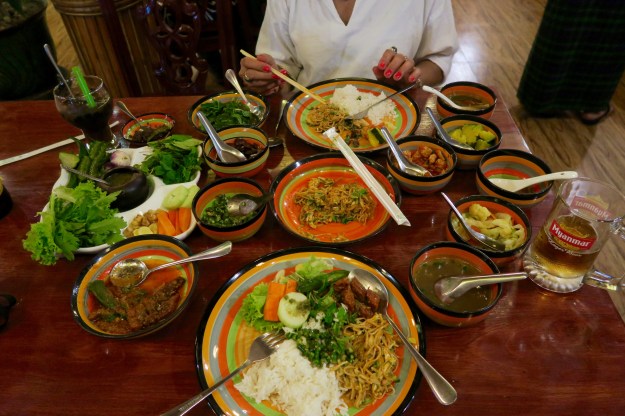
A long, but VERY satisfying and enjoyable day. It only remained for us to walk to a local restaurant for supper. We had been warned not to order side dishes as they are generous with the portions, but it was still a feast and, even with a beer, cost a massive £7.50!

img_2095

And the picture does not include a complementary dessert!

Well, definitely time to post this. I have to get started on yesterday’s outing!

Till then……

” On the road to Mandalay…..”

17th January, 2017

We arrived in Mandalay and were met at the airport by the wonderfully loquacious Ting Ting Noay, spelling to be verified and known as Noay, who is our guide here in Mandalay and our driver, Mr Soe. She briefed us on our way to the office (that is a bit of an exaggeration) of the tour company as to our programme and lots about Myanmar, not least about recent changes. I will try and give a bit of background when I have the chance. At the office, we met Ma Kai (as in Mackay from Porridge), Ma being Mrs, who is the local boss and who dealt with all the paperwork. It was then off to the Bagan King Hotel and time to settle into our new home for the next four nights. The room is good, though bizarrely there are no drawers and very few surfaces, especially in the bathroom. Makes you wonder who designs these rooms. Still the bed is enormous – you could sleep sideways with ease! I will need a map reference to find Val!

Ok, there you have the standard hotel room pics. We went out for a walk after dinner and to get a feel for the place. First up, Mandalay was only founded in 1857 by King Mindon on a very specific grid system (they are heavily into astrological calculations here), was captured by the British in 1885 and grew from there to the Second World War when it was captured by the Japanese and bombed by the Allies. It is a busy, rather dusty and polluted city, fairly noisy due to a fair bit of honking and known locally as Motorbike City. One effect of the grid system is that, of course, you get a lot of junctions. Unlike say New York, they don’t have many traffic lights or rights of way, so to get across the junction you simply sound your horn and go for it, weaving to avoid everyone else doing the same thing. Force majeure and who dares wins spring to mind! Our walk was suitably exciting when crossing the road, but we are fairly used to it and you have to trust that they will weave their way past you. Pavements are at something of a premium here as well, so it is never dull. Val says it reminds her of growing up in Malaysia in her youth some 50 years ago, which tells you something of the state of the economy. Until very recently Myanmar was number 201 out of 228 countries economically and had a GDP of $1,700 per capita compared to $9,900 in neighbouring Thailand. Things seem to be improving as the generals and the military have loosened their grip on the country a bit. Mobile phones are now the latest phenomenon – the price of a SIM card has come down from about $600 five years ago to something affordable now. It is all happening very quickly, but they do have a long way to catch up. And there is no guarantee the military won’t intervene again.

We walked up to what remains of the royal palace which has a moat and walls and is mostly an off-limits military zone with little left of the royal palace. Still, photogenic. I enjoyed the sign outside a restaurant advertising their wares.

We may try the tight chicken dish one night!

By the way, Kipling has quite a bit to answer for by romanticising Mandalay in his famous poem, not least as he never actually visited the city. He was on his way back home and the ship dropped in on Rangoon, so time for a quick poem (which is also a song sung to a waltz tune of the day, I believe) where a long-time soldier is looking back from a wet and gloomy London to his days ‘east of Suez’. I attach a link for those of you who need reminding – there are some good notes on it as well:

http://www.kiplingsociety.co.uk/poems_mandalay.htm.

There are a few dodgy geographical moments – the ‘old Moulmein pagoda’ is on the coast, whilst Mandalay is in the middle of the country and you cannot see China ‘crost  the Bay’ from either location as it is some 500 miles away! That said, it is a very emotive poem I always feel, especially if you have lived or visited these parts.

I am posting this now as we had a very busy day yesterday and I need to get it all organised. And we are off shortly on day two of our tour. I will try and catch up a bit tonight.

Bye for now!


Carry On Up The Jungle!

Saturday, 14th January, 2017

Well here we are in the Bangkok Airways Lounge at Chiang Mai airport waiting for our flight to Bangkok and thence to Mandalay. I am not sure I have been invited into a lounge before. This one is pretty basic, but does have free coffee and some very basic sandwiches, which is most welcome at 5.45 in the morning. Our flight will no doubt be called soon, but I will see how far I can get with this post in the meantime. Of course, if I hadn’t written all that waffle about lounges, I would be well on my way. And that last bit doesn’t help!

Ok, our second tour in as many days. Once again, the sun shone and the temperature was like a nice summer’s day in (southern) England. We were picked up by the same tour company at about 0830 and settled down for a longish drive to the National Park. As ever we were a nice international company with French, German, Omani, Danish and Thai. It is a great way to find out more about other cultures and people without actually having to travel to their countries! The star of the show, though, was our guide for the day, Banana – which is what he insisted we call him. As far as I could understand it, everything depends on the way you say a word as there can be 5 different intonations each meaning something different. I am guessing his name was something like gloo-ey, the Thai for banana. Our driver went by the name of Same-Same (I think!).

Today it is another ‘carry on up the jungle’, stopping first at a waterfall…

(We are now ensconced in the Bangkok Airways lounge in transit at Bangkok Airport. Same coffee, slightly better snacks and German footie on the TV. The airport is awash with Leicester City FC due to the Thai King Power connection. Such fame!)

Back to the jungle. The waterfall was a nice break in the journey, but the main attraction was to be the king and queen stupas (stupae?), built to honour the 60th birthdays of King Bhumibol in 1987 and Queen Sirikit in 1992. Great views and nice gardens, though the stupas themselves are rather severe. Mind you, other than covering it in gold, the structure itself is a bit limited as regards variations on the theme. It seems that the varying shapes, such as they are, may represent different things:

The square base represents earth
The hemispherical dome/vase represents water
The conical spire represents fire
The upper lotus parasol and the crescent moon represent air
The sun and the dissolving point represent the element of space

There are 5 types too – relic (has a bit of the Lord Buddha), object (has something belonging to him), commemorative (of events in his and his disciples lives), symbolic (of aspects of Buddhist theology) and votive (to gain spiritual benefit). I hope that clears up any misunderstandings – I could go on…..

Great ornamental cabbages.

From there we were off again to the highest point in Thailand. Lots of the locals like to  be photographed next to the sign that gives the 6.00am temperature, which on our day was 6 degrees. Nice little stupa and I particularly liked the elephants.

Off again, you don’t stand around for long on this tour. Next was a visit to some stalls selling a wide variety of local products from honey to dried fruit, wine and fruit. Again, all part of the Royal Project. Some nice faces (including Val).

And off we go again – another waterfall, lunch and another Hmong village similar to the previous day, though not as developed, but with some stunning fabrics….

And that, as they say, was that, other than the long ride back to the hotel. A good tour.

Sunday we kept holy (sort of) with one last indulgence at our friendly spa, then packed and relaxed. Our lovely spa ladies, Mimi and Noi, kindly posed for a photo. I feel like a giant here!

And that’s it, folks, the end of the Thailand leg of our Asian Vacation. I can’t believe it is over already. Next stop, Mandalay!