Author Archives: jfbemanuelorguk

Ooty here we come!!

OK, I am back with WordPress – a long and difficult journey, but hopefully normal service is now resumed!

8th January, 2019 – Into the hills and far away.

We left Mysore and headed due south towards Tamil Nadu and the hill station of Udhagamandalam, also known as Ootacamund or, thankfully, Ooty for short. In its day, it was also known as Snooty Ooty, after John Sullivan clambered up there to ‘discover’ this corner of the Nilgiris (literally ‘Blue Hills’) in the early 19th Century. It was occupied then by the pastoralist Toda hill tribe, who had lived pretty much in total isolation until then. Sullivan realised the agricultural potential, bought tracts of land at 1 rupee an acre and proceeded to plant vegetables, fruit, flax, barley, hemp and especially tea. It then seemed a good place for a hill station which saw it thrive still further.

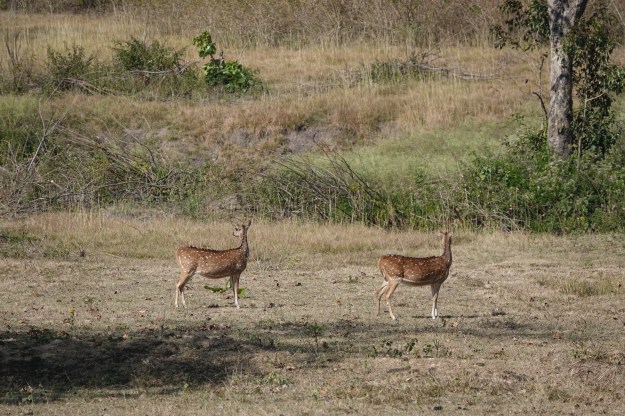
We drove up and up and up through two National Wildlife (Tiger) Reserves sadly only seeing what presumably is the tiger’s lunch, ie deer and only a distant sighting of what looked like a tame elephant.
DSC00485

This trip has been two deer!

DSC00489

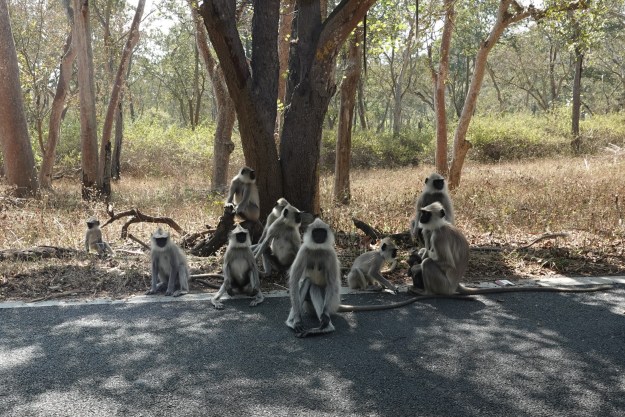
Don’t monkey with these guys!!

DSC00491

The rather tame elephant.

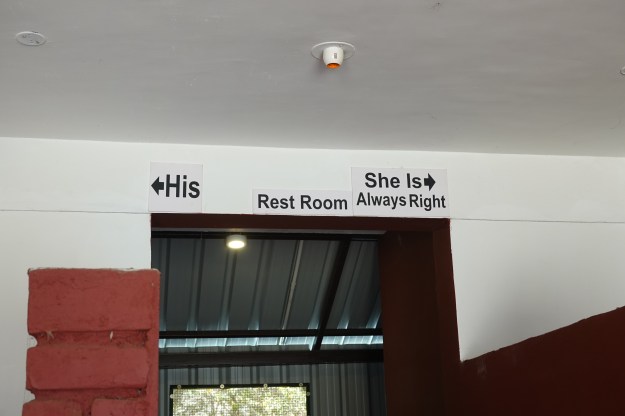
We did stop for a break and spotted this interesting sign!
 

DSC00493

No caption needed, I feel.

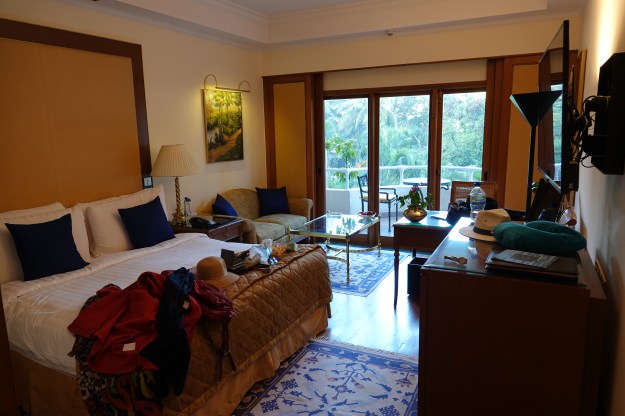
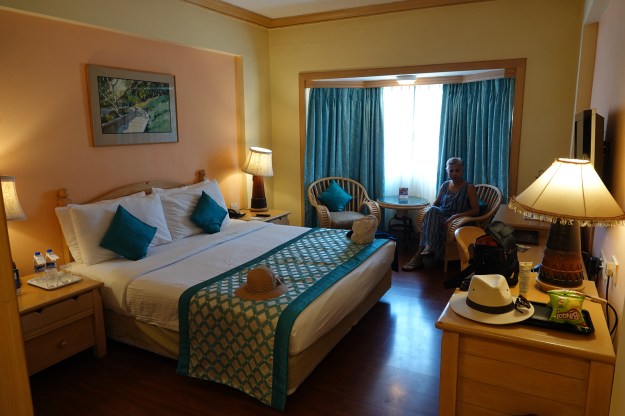
It was a longish and very windy road to the top, but you did get to countdown the number of hairpin bends, as each one was numbered out of 36. We arrived about lunchtime and checked into our hotel, the Fortune Sullivan Hotel, a bright modern affair where everything seemed to work ok, if not as inspiring as some we have stayed in in India.
DSC00496

Our comfortable room at the Fortune Sullivan Court Hotel, Ooty.

DSC00541

The unusual foyer of the Fortune Sullivan Court Hotel, Ooty.

After a bit of a rest, it was off again, though we were a little hesitant after all the twists and turns of our ascent. Still, reasonably undaunted, we set off with our new guide, Jon (spelling?) and drove off to the Dolphin’s Nose, a viewpoint where you can look at the plains of Tamil Nadu (well a bit – it is very hazy). We had not appreciated the amount of time it would take to go not very far due to the road’s width and surface as well as the traffic, but it gave us a chance to see some of the vegetable and tea growing as well as to experience pollution at about 7,000 feet! My cold had now turned into a really impressive and irritating (to Val especially – ‘how can I sleep through that?) cough, exacerbated, I think, by the altitude and the pollution. As it is nice and cool up there (18C), you don’t need the aircon in the car, so all the fumes came in instead.

I would add that Ooty and the neighbouring towns like Coonoor are not the leafy suburbs of Surrey and hills of Scotland they used to be, but are now the usual cacophony of cars, buses, tuktuks and people all jostling for space. The town is popular with local tourists who come up to savour being cold. It can get down to near zero at night. 


DSC00499

The Nilgiris – or Blue Mountains

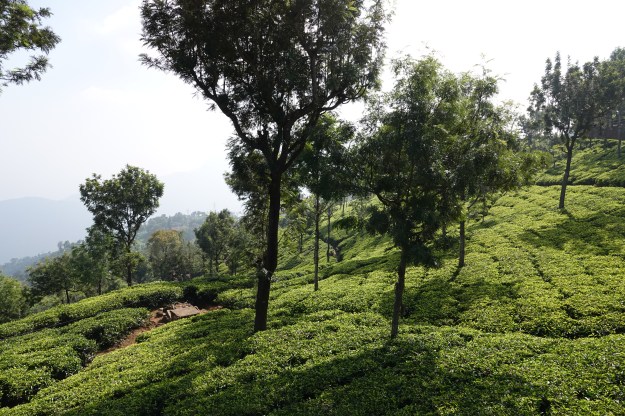
DSC00501

One of the many tea plantations – a very tidy crop, I always feel.
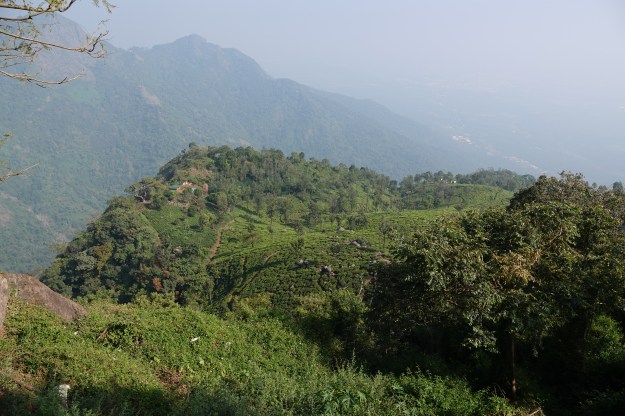
DSC00506

The view from Dolphin’s Nose, near Ooty.
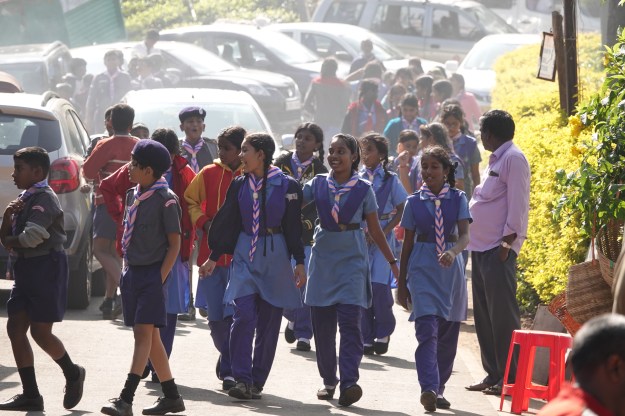
DSC00509

The Ooty Scout Troop on the march!

We then agreed to visit Doddabetta, Nilgiris’ second highest mountain at 2623 metres, which was a bit of a mistake as it seems the Forestry Dept purposely keeps the road up to it in a dreadful state to discourage visitors, presumably to preserve the forest, so it was very slow, painful progress to the summit and to see the rather hazy view.
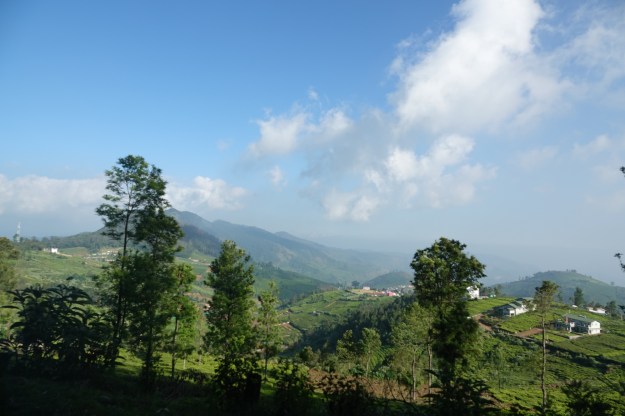
DSC00512

The view from Doddabetta Mountain.

From here it was back into the car and what turned out to be our final stop (we declined to drive to the lake), the Botanical Gardens, laid out in 1847 by gardeners from, you guessed it, Kew (they certainly got about!). Lots of varieties of trees and plants imported from around the world and LOTS of locals out for an evening perambulation.
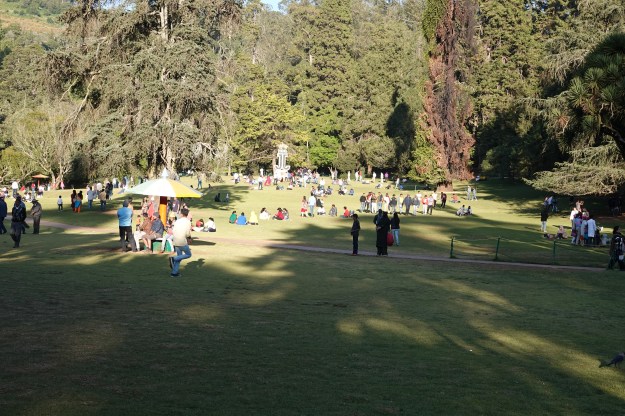
DSC00520

Lots of locals out for an evening stroll in the Ooty Botanical Gardens.
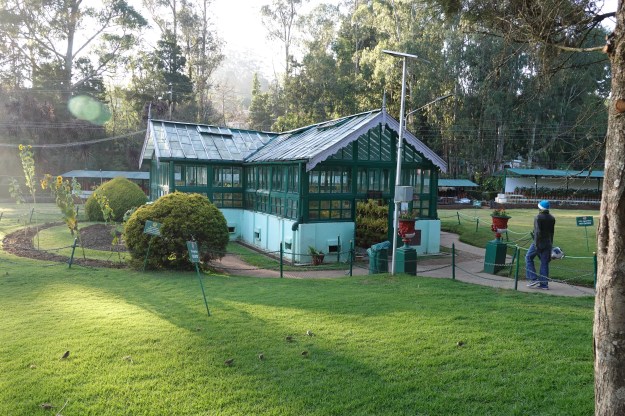
DSC00521

The original greenhouse!

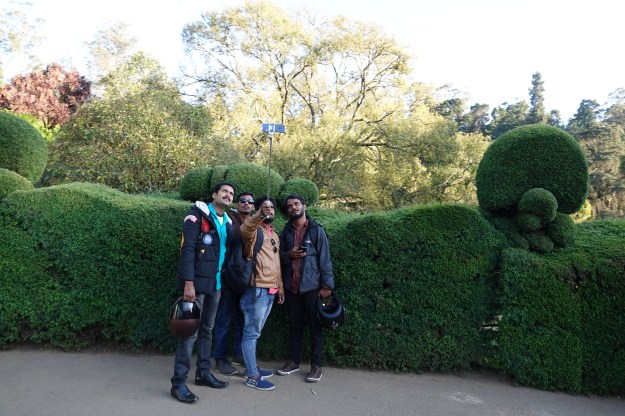
DSC00525

Some serious posing!!

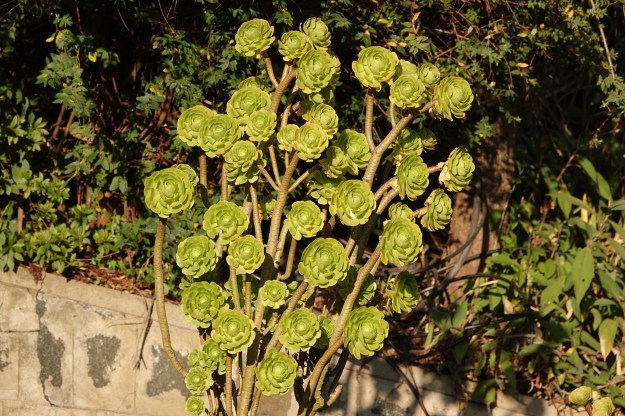
DSC00530

Not sure what this is!

DSC00532

Or this – some sort of daisy?

DSC00533

Looks like heuchera – but I don’t think it is….

DSC00534

A small heron?

DSC00535

OK, we know who these guys are! Val looks like she is meditating!

And so, after a long day (at altitude) with my cough sounding more and more impressive, we sank back into our hotel for a well-earned night of rest (and coughing).

Mysore -An Exotic Palace, a Temple on a Hill and a Large Bull!

7th January, 2019 – Mysore

Before we get under way, I should point out that Mysore is now Mysuru, but everyone still seems to call it Mysore. Just in case there are any pedants out there (as if). It is a centre for sandalwood-carving and silk and incense production – though we managed to resist most of what was on offer, but more about that later. My guidebook describes it as ‘charming, old-fashioned and undaunting’ and I would very much agree. It feels manageable, so much so, Val and I explored a bit on our own on foot. More in due course.

A good breakfast was followed by a short drive to the Palace, now to be seen in the daylight (it is still pleasantly warm and sunny, in case you were worried). It is just as impressive in the daytime with large surrounding grounds with a bit of garden, lots of temples and a parade ground. I have to confess, that a rather exotic railway station does spring to mind at times, but it is certainly very regal.

The Palace was designed in the Indo-Saracenic style by the British consultant architect of Madras State, Henry Irwin and completed in 1912 for the 24th Wadiyar raja on the site of the old wooden palace that had burnt down due to a stray firework at a wedding ceremony in 1897. There are various interesting things inside, including two enormous mounted elephant heads and a howdah decorated with 24 kg of 24-carat gold with a red and a green light on it that look like jewels, but were there so that the raja could tell the mahout when he wanted to go or stop. The overall decoration is eclectic with Belgian glass, Italian marble, Bohemian chandeliers and British floor tiles. A few photos…

As you go up the grand staircase you pass an unnervingly realistic life-size figure of the raja of the day and then enter the magnificent Public Durbar Hall with views across the parade ground at the front of the Palace. The raja would give audience here seated on a throne made from 280 kg of solid gold (not on sight!). I on the other hand was the subject of about 10 selfies with a group of young men assuming the most dramatic poses in the style of the latest Bollywood stars. I suggested 100 rupees a picture, but they weren’t feeling generous. A few more pics for you…

It was time to head off to our next stop, which was, you guessed it, another temple! This was at the top of Chamundi Hill dedicated to the chosen deity of the Mysore rajas, the goddess Chamundi or Durga. There were certainly a fair number of people there and some interesting sights!

And finally, as promised, a large bull, our old friend, Nandi, Shiva’s bull. And there was a convenient sugar cane seller nearby for a restorative glass of sugar cane juice with ginger.

And that was Mysore, other than a walk down the main shopping street, photos of which I do not have as the battery died on the camera or, as it expressed it, ‘the battery is exhausted’! There are more clothes shops for men than women there I think, but Val did buy a really lovely cream and gold outfit, which is planned for Clara’s wedding. Of course we then needed shoes (luckily not handbag, hat and jewellery) and where do we end up but only the Mysore branch of Clarks!

Another great day and it is off to the hills tomorrow (as in 8th January).

To Srirangapatnam and Mysore!

6th January, 2019 – Srirangapatnam

We set off after breakfast from our lovely Oberoi Hotel and were sad to leave as it really is the sort of hotel that you feel you could happily stay in for a lot longer. Lovely staff and excellent service and facilities. But it was time to head south for Mysore, though with a special stop en route, that being Srirangapatnam, the site of a British victory in 1799 in which the future Duke of Wellington took a major part.

Being Sunday, the traffic on MG Road was nice and quiet and we were soon on our way through the outskirts of the city and into a bit of countryside. It is a longish drive to Mysore of at least 4 to 5 hours, especially when your driver sticks to a very modest (and no doubt sensible) 60 to 70 KPH tops. I sat in front and seemed remarkably calm as we wove in and out of the traffic with millimetres to spare. We only had one scare which was when a kite (of the bird variety) swooped down for a tasty morsel right in front of the car, which gave us all a bit of a start, but nothing compared to how the motorcyclist behind us must have felt!

We stopped for a coconut en route, a wonderfully refreshing drink – and you get to eat it as well. I add a few other pics as well of sights seen as we travelled.

We arrived in Srirangapatnam just after lunch and met our new guide, Devarajah at the Summer Palace of Tipu Sultan. OK, time for a bit more history (oh no, do we have to, sir? Can’t we just have more photos? Please, sir.). No – and there will be a test when I get back!

Srirangapatnam is a tiny island in the Kaveri or Cauvery River, about 5km by 1 km, about 14 km north of Mysore. Originally it was the site of a temple to Vishnu built in 1133 and became a fort in 1454 and in 1616 it was the capital of the Wadiyah Mysore rajas. It is also associated with Haider Ali, who deposed the Wadiyahs in 1761 (he had been one of their trusted generals – big mistake) and who, with his son Tipu Sultan, transformed the small state of Mysore into a major Muslim power. Both of them wanted to rid India of the hated British invaders (the East India Company) and there were 4 wars, ending here, at Srirangapatnam in 1799 when the British forced a breach in the wall of the fort, sent in two Forlorn Hopes to take the breach and captured the fort. Tipu Sultan, the Tiger of Mysore, died in the fighting. The future Duke of Wellington, Arthur Wellesley was involved in the siege and later ran the area as governor.

Our first port of call was the summer palace or Daria Daulat Bagh, literally meaning ‘wealth of the sea’. It was built in 1784 and is richly painted and decorated, not least with a mural of the Battle of Pollinore in 1780, a victory over the British (with French help). I will let the captions on the photos explain further.

We then drove to the Gumbaz mausoleum, also built in 1784 by Tipu Sultan like the palace, to commemorate his father, Haider Ali, his mother and, as it turned out, himself (courtesy of Colonel Wellesley).

OK, finally we made it to the fort itself – or at least what remains of it. You can still see quite a few bits of the walls and what surprised me was the small town that was inside it, complete with railway line. There were a few site’s such as Baillie’s dungeon and the place where Tipu Sultan’s body was found, but all-in-all, it was a bit disappointing, though perhaps with more time it would have provided more detail regarding the battle. Some photos….

And then it was on to Mysore and checking in to our next hotel, the Royal Orchid Metropole heritage hotel. It was built by the Mysore raja of the day in 1920 for foreign guests to stay in and is certainly quite long on the heritage with a big room, but I am not sure the plumbing had been updated since it was first put in. Comfortable enough though, although after the Oberoi it felt like a step down with some rather uninterested staff. Here is the compulsory shot of the room and some other views.

We were not finished for the day though as Sunday night is the one day of the week when the Mysore Palace is lit up for one hour with some 5,000 light bulbs  for the general public to come and enjoy. Now, to be honest, Val and I both thought it would be like a son et lumiere show, whereas it was more like Harrods (on a grand scale) with a slightly dodgy military brass band playing some just about recognisable marches. Still impressive though and all free, so worth the trip.

And that was that for a full and very good day’s sightseeing. Back to the hotel, a bite to eat and bed.

More soon (I am having trouble keeping up – and I am almost at the end of the allowance for photos with the package I have with WordPress, so we might have to do something desperate like switch to another blogging host. We shall see.).

Bangalore!!

5th January, 2019 – A Tour of Bangalore

Val got off to a stunning start by heading for the gym before breakfast whilst I slumbered on. It is a holiday and I still have my cold (aaahhhh, I hear you say). Another excellent breakfast, this time appam for Val with the chef coming out to present it himself along with his business card. I am not sure when we will be contacting him, but it was a nice gesture.

Our guide, Sri and the faithful Pandi met us at the hotel and it was off for our tour of Bangalore or at least bits of it as it is very big. As it was a Sunday, the traffic was a bit better, which is a bit of a relief and we headed south towards our first destination – the Lal Bargh Botanical gardens. A bit of history first.

Bangalore is the capital of Karnataka, but only since independence and from 1400 to 1947 the area was ruled by the Wadiyah royal family from Mysore with son help from the British. The Wadiyahs were temporarily deposed from 1761 to 1799 by the Mughal Haider Ali and his son Tipu Sultan, of whom more in due course. The British overthrew the latter, restored the Wadiyahs and set up a military cantonment in Bangalore.

The city started as a village, founded by Kempe Gowda, a devout Hindu in 1537 and he built 4 watchtowers some distance from the corners of the village with the expectation that the village would expand one day to them. Which of course it did and some. One of the towers still exists in the Lal Bargh gardens and was the first thing we saw atop an impressive mound of rock. The garden was started by Haider Ali in 1760 and expanded by his son with the British bringing in gardeners from Kew in 1856, who built a bandstand and a glasshouse based on Crystal Palace. The whole area covers 240 acres and is most impressive and big step up on the park we saw in Mumbai.


A word about the weather, it is a bit chilly first thing, maybe 12 degrees, but it warms up nicely to about 28 during the day with no humidity, so we had a very pleasant walk through the gardens. I would add that Bangalore is about 920 metres above sea level, which helps. I trust the weather is nice wherever you are.

Next stop was the Bull Temple, built by the resourceful Kempe Gowda in the 16th Century and housing Nandi, the bull god, carved from one, very large, piece of granite. Lots of souvenirs on sale too, of course.


Back to the car and a drive around some of the city, passing Tipu Sultan’s Summer Palace which unfortunately is not in a good state, so we just had a look from the outside before heading off to the City Market.


Now regular readers of this blog will know that Val and I LOVE markets and you will also know, that I cannot resist taking loads of photos, but I will try to limit this to the best ones. There was so much to see with all sorts of vegetables and fruit, flowers for the temple and even pots and pans as well as all the colourful people to go with them. I could have spent a day there!

We had time for a drive about the city where we drove through Cubbon Park, another large green oasis of about 120 acres in the centre of the city equipped with its bandstand and statue of Queen Victoria. We also stopped to admire the vast State Legislature building or Vidhana Soudha, built in 1956 opposite the High Court of Karnataka.

Ok, one final stop and that was Sri, our guide’s, favourite drinking spot, the Bierce Club, one of the many micro-breweries in Bangalore for a cool beer and some nachos.

Ok, this blog is now quite long and needs to Ben posted. Suffice to say, we had a nice dinner in the hotel and slept well. Off to Mysore tomorrow…..

More soonish….


Here We Go Again!

3/4 January, 2019 – On the Road to Bangalore 

Yes, we are off on our travels again and I am typing this from our fabulous room in the fabulous Oberoi Hotel in Bangalore or, to give it its correct modern (and pre-colonial) name, Bengaluru.

DSC00166-1

We had a nice flight with BA, though we were an hour late departing first due to a minor problem I think getting one of those airport trucks to push us back and then one of the passengers was ill, which meant they had to call a medical team who decided she was not fit to fly and had to take her and her luggage off the plane. I could have told them before she boarded as she seemed very peculiar while we were waiting in the lounge, as though she was suffering the effects of drugs. Still, a minor inconvenience and better safe than sorry. We had 3 seats to ourselves so could spread out a bit and make ourselves comfortable while getting down to the serious matter of movie watching.

We landed late in Bangalore (6.00am), but were met by Pandi, our driver for the trip, who did not give a very good first impression by being unable to get the car out of the car park and could we loan him 50 rupees! I suppose these things happen, but he also had a bit of difficulty finding the hotel, so we are not overflowing with confidence.

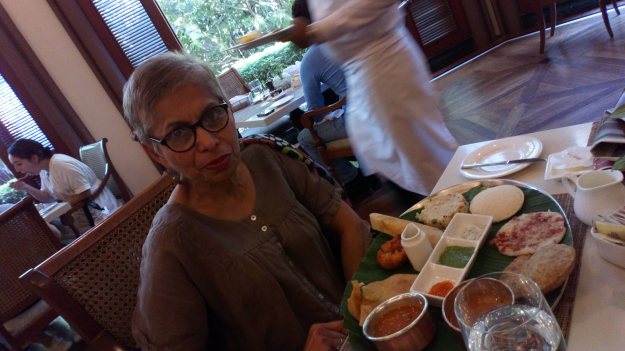
Lovely hotel, massive room and they even let us have breakfast on arrival, which was good and Val immediately cornered the chef who brought out a plate of goodies, which made her very happy (though she may not look it in the photo, probably because I was stopping her from tucking in) and got us off to a great start. We then needed sleep, though Val, my Duracell bunny, still found time to go to the gym, before a little afternoon snack, a walk around the garden and a bit of rest time before heading out to find a restaurant for supper.

DSC_0004-1

Val enjoying her breakfast on our first day.

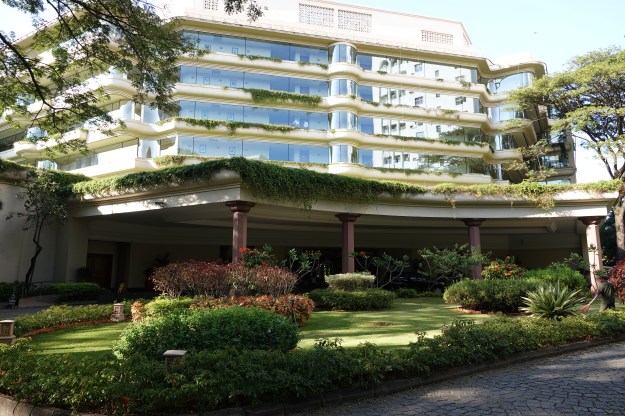
The Oberoi Hotel, Bangalore

Front of the hotel

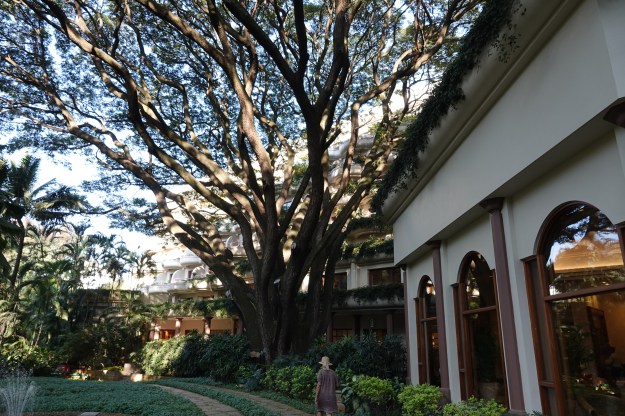
DSC00170-1

Fabulous tree in the garden of the Oberoi Hotel, Bangalore.

DSC00174-1

Oberoi pool

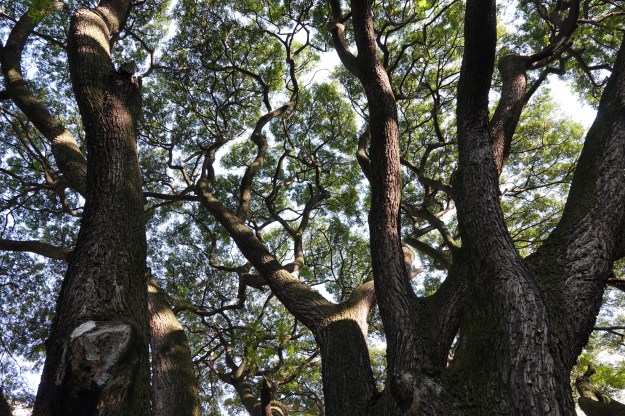
DSC00171

Stunning rain tree.

This we did by walking along MG Road (MG as in Mahatma Gandhi – there is one in every Indian city), which is one of the main thoroughfares of this bustling city. Bangalore has quadrupled in size in a very short time to something like 12 million people as it has become the IT capital of India. It is known as the Garden City, due to some very large parks (more on them soon) and is home to some big army and air force bases, which give the city a more spaced-out feel to it with wide roads and plenty of big rain trees shading the roadside. The traffic is the usual Indian magic of tuktuks, buses, cars, motorbikes and the odd cow all managing to convert 3 lanes into 6 and showing off their prowess of judging time, space and movement down to their last millimetre. Not for the faint-hearted and we had to be bold just to cross the road, but we have been well trained on our travels and it was no worse than Hanoi.

A lovely dinner of South Indian food and then we made our way back to the hotel through the traffic, making sure we did not trip over the pavement or garrotte ourselves on the dangling electric wires. We were both impressed by how clean the city centre is, with no one sleeping rough and largely ok pavements, at least by Indian standards. It was a big improvement on Mumbai. And so to bed and an attempt to catch up on the jet lag.

Time to get at least one blog posted…. more soon.

Corner Brook & Sydney – Honorary Newfoundlanders and another Wash Out

26th September, 2018

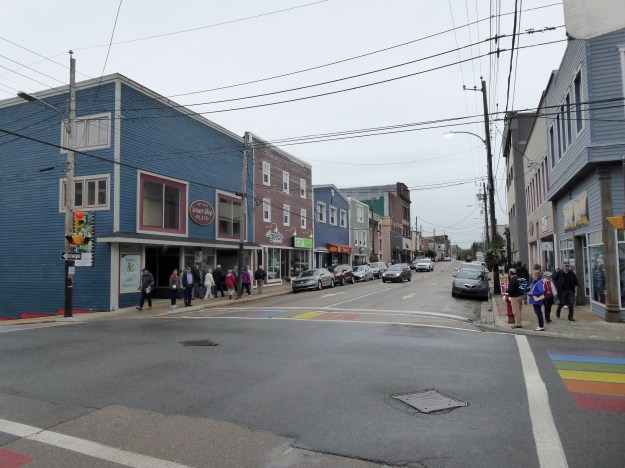
Our penultimate port of call was Corner Brook, on the west coast of the island of Newfoundland. For reference, Newfoundland is the part of North America nearest to Europe and the island is about the size of Bulgaria and, with Labrador, is Canada’s newest province. Corner Brook has the fame as Canada’s snowiest city with an average annual snowfall of 162 inches and was only really developed when a Mr Gay Silver opened a sawmill there in 1864 with further development coming when Sir Eric Bowater opened a pulp and paper mill in 1925.

Val and I caught the free shuttle bus into the city and wandered about a bit and then found the way to the Corner Brook Stream Trail, which led, eventually to a charming walk around the local dammed lake. I say eventually, as we first walked around what we thought was the lake, but proved to be a rather disappointing pond (though it did have some photogenic reeds) and we were delighted when we discovered the right path and the lake proper.


Some nice wildlife too…….

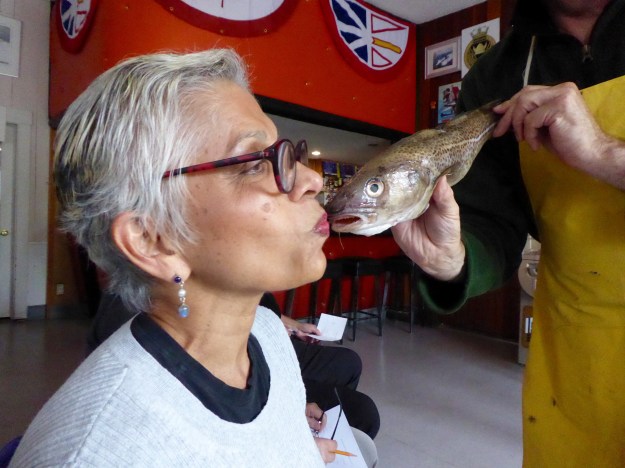
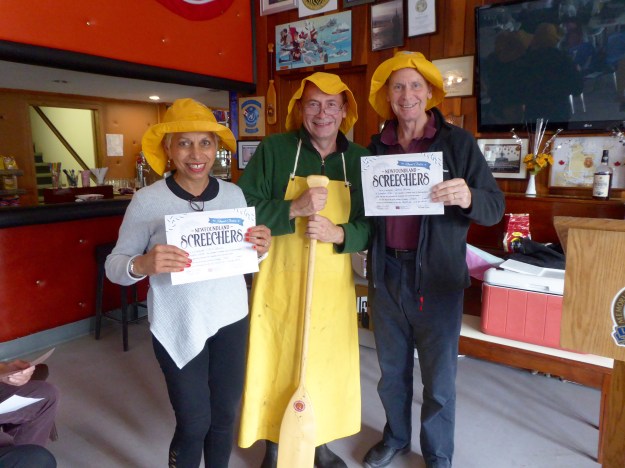
Our next and final stop was one with a difference and involved a visit to the Canadian Legion. This is like the Royal British Legion……but Canadian (!). This had been recommended on the shuttle bus and we first helped ourselves to a bowl of moose soup and a roll of bread. The former, probably not too surprisingly, tasted a bit like a beef stew, but at least we can say we tried it (even though moose is not native to Newfoundland and had to be introduced). The next part of the session was a Screech In. What, I hear you ask, is a Screech In? Well it does back to something to do with drink, some US airmen and WW2, but for us it was the ceremony to make us honorary Newfoundlanders.

It started with us replying to some Newfoundese (?) asking who our parents were and what our name said were. Nothing that remarkable about that, though there were 5 men and 5 women taking part (all Brits) and all the men were called John. And, to cap it all, the guy leading us was also called John! We then had to answer some questions on a sheet of paper, starting with putting a dot on the i. Of course we all put the dot above and not on the i, so we all failed that test and had to sing a song collectively – God Save The Queen was the only one we all knew. The next question had the following: PB – 200lbs, MB – ?lbs, BB – 50lbs. Now, if PB is Papa Bull and he eats 200lbs a day and BB is Baby Bull who eats 50lbs a day, how much does MB – Mama Bull eat? Of course we all put down a variety of numbers before being reminded that you don’t get Mama Bulls! We then had to recite a poem, but as a collective one was going to be tricky I volunteered to recite one, which seemed to do the trick (“T’was an evening in November”….. – you can Google the rest).

Next we were asked which two words were related out of Drum, Egg and Sex. Again most of us linked Egg and Sex, but we were wrong again as the the answer is Drum and Egg as you can beat a drum, you can beat an egg, but you can’t beat sex! This time we all had to do a jig.

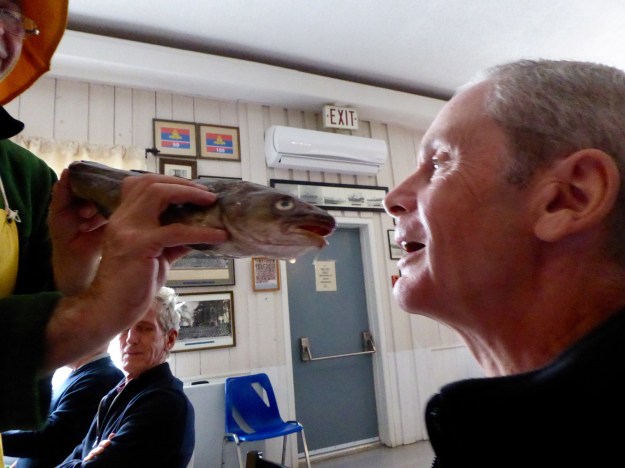
We also had to eat some,what I believe is called, balona but was very like Spam, some pain dure or hard bread (like a cracker) and then kiss an Atlantic Cod (a small one – apparently they can grow to 6 feet). Not the most pleasant experience, but we all did it, as the photos show. We were then given our certificates and we have to come back in 7 years time. All very silly, but a good laugh and great fun.

P1030025P1030026P1030028

The rest of the town was much of a muchness, so it was back on board and off to our last destination, Sydney, Nova Scotia.

27th September, 2018

We had one of the few choppy nights of the trip, but it was calm enough in the morning, which was important as we were to be tendered ashore at Sydney. This city was home to a vast quantity of shipping during the war and was an assembly port for the trans-Atlantic convoys and had a thriving coal and steel industry though that has declined in recent years. Sydney is the capital of Cape Breton Island which is a bit bigger than Cyprus. Lots of cruise ships visit though and we had 3 in when we dropped anchor in the bay.

Unfortunately, the rain was back, so it was a quick walk along the boardwalk and the main shopping street (which resembled something out of 1970s UK a bit) and we had then had enough and headed back to the ship.

P1030032

Not a vast amount to see in Sydney itself and a pity the weather had not been kinder. With more time it would have been good to have got out of the city and visit the Alexander Graham Bell museum (he lived on Cape Breton Island) and to see where Marconi sent the first west-east wireless message in, I think, 1902.

One photo of a heron and one of one of the other ships visiting, but that is about it, I regret.

We have had a good trip and I will try to get some general thoughts down regarding this, but, having bought some time on the internet, I will now try to get this posted.

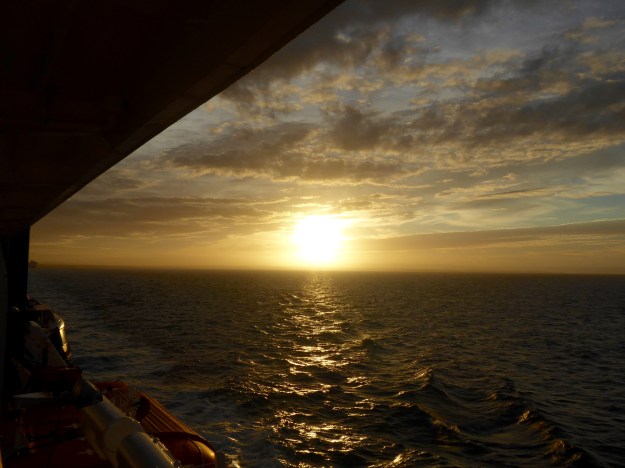
That didn’t work as it was not powerful enough to upload the photos, so I have completed this at home. Finally, here is a sunset as I know you would be disappointed to have a trip without one!

P1030033

Charlottetown and Iles de la Madeleine – Pleasant and So-So

24th September, 2018

Another sea day (back to the gym and the launderette) and then we arrived at Charlottetown, PEI, an acronym much in use (PEI ice cream, PEI potatoes, etc) and which it took me a while to appreciate means Prince Edward Island. Charlottetown is the capital of Canada’s smallest province and has two claims to fame – it was the host in 1864 of the first of several conferences that united Canada as a dominion in 1867 and thus is often referred to as the birthplace of Canada (though interestingly PEI only joined in 1873). The other thing that puts PEI on the map is Anne of Green Gables as the author, L M Montgomery lived on the island and based her stories in the area. The first one, published in 1908, sold 19,000 copies in the first 5 months.

It is definitely a popular stop with the cruise ships and for a small city (population 36,000), it has an astonishing number and variety of restaurants, no doubt catering for the demand. It has the now familiar grid street system with plenty of attractive buildings and featuring the Anne of Green Gables Chocolate Shop and the Anne of Green Gables Souvenir Shop of course.

There was also the usual fairly sober Anglican church versus the more flamboyant Catholic basilica.

The sun shone and we enjoyed the city, which has a lot of civic pride and plenty of the usual welcome that we have come to expect in the Maritime Provinces.

P1020979

25th September, 2018

Our next stop was the Iles de la Madeleine, which are a 62-mile long hook-shaped archipelago of 16 islands in the Gulf of St Lawrence, part of the Province of Quebec. That, I regret, is about it. We did leave the ship and Val had a brief look at the few shops there were and I walked up the 185 steps to a look out over the harbour and the town. And then we went back to the ship. Not very exciting, but pleasant enough……

Quebec – Come Rain, Come Shine!

21st September, 2018

We were docked in the commercial port a little further up the St Lawrence River, but only a 5 minute shuttle bus ride to the Lower Town of Quebec. Unfortunately we had arrived on a day when the heavens decided to open, but we set off anyway with our waterproofs on and hoods up and joined the throngs of fellow tourists.

Quebec is the only North American walled city north of Mexico and was founded by Samuel de Champlain in 1608 initially as a trading post. It was made up of the Lower Town which was the commercial area and the Haute-Ville or Upper Town at the top of the cliffs. The cliffs of course became very famous on 13th September, 1759 when Wolfe led his men up to the Plains of Abraham where he defeated the French General Louis de Montcalm. Unfortunately both young generals died that day, but it was a day that saw the defeat of France in North America. Interestingly the British sensibly passed the Quebec Act in 1774 that gave the French Canadians recognition of their separate culture, which meant they did not rebel against the King when the Americans did .

Well, enough of the history lesson, back to our soggy sightseeing. We first made our way to the Place Royal in the Lower Town, with its cobbled streets and church to Our Lady of Victories, the oldest standing cathedral in North America. The rain had eased a bit, so I was able to take a few photos.

However, as it started to come down even heavier, we were better off browsing in the innumerable art galleries and craft, jewellery, clothes and souvenir shops. We finally saw a Mountie (well, sort of) and the sort of animal head that you can safely put on the wall (though the angle of the photo makes it look as though the moose has a snowshoe for a tongue!).

It was then up the funicular railway to the Upper Town, where you are greeted by the imposing and enormous Chateau de Frontenac, a hotel built in the late 1893 by the Canadian Pacific Railway and definitely the dominant feature of Quebec. We popped inside to escape the rain and had a look at the busy lobby and the impressive postbox.

It was then out again, a quick walk around some of the nearby streets and then down into the funicular and diving into a bar/restaurant for a ‘comfort break’. In the end, we were tempted by the soup they were serving (mushroom for Val and beef for me) and I had a glass of a local beer called La Fin du Monde, which at some 9% almost lived up to its name. The rain, sadly, was still hammering down, so we decided to call it a day and head back to the ship in the hope that the next day would bring better weather.

22nd September, 2018

We woke up to sunshine! We only had the morning in Quebec, so we got away on the shuttle bus quite early and saw what Quebec can look like when the sun is shining and what a difference. Mind you, it also brought out the hordes of tourists and you also saw what a tourist trap the city is. There were other cruise ships in town and we jostled with Americans, Chinese, French and lots of other nationalities in the Pace Royal.

I wanted to check out the battlefield of the Plains of Abraham and as Val was not so keen we parted company, she window shopping and me heading off for the Upper Town and beyond.

I had a quick look at the bits of the Lower Town we missed the day before and then set off up the hill to the Dufferin Terrace in front of the Chateau de Frontenac which provides a superb promenade and views over the Lower Town and the river.

I had a rough idea of where I had to go, so I started walking along the promenade in a westward direction, passing a toboggan chute from 1884 and passing by the Citadel which is the residence of the Governor-General when in town. I had not appreciated the number of steps needed to get to the end of the terrace (over 300, I was later told), so I was nicely warmed up by the time I emerged from the trees onto the Plains.

There was a useful diagram of the Plains and I decided I would at least view the spot where Wolfe fell. The only thing the diagram didn’t enlighten me about was how far it was! Still, it was a lovely day with lots of Quebecois enjoying their Saturday, running and walking their dogs in the very extensive park. There was also some nice houses and a number of Martello Towers built to repulse the revolting Americans in the War of 1812. I finally made it to the monument after some dodgy French to ask the way, which was good enough to get a long reply the gist of which is that it is down there on the gauche.

The monument is by the impressive Musee des Beaux-Arts and I attach a photo of both and the area where much of the battle took place.

Time was pressing, so it was off again at pace, walking through the park, past the bandstand and a black squirrel.

I made it back to the Citadel, had a quick look at the gate, but decided there was not enough time to go in, and then explored the Upper Town. There is some fabulous architecture there and you really do not feel you are in North America at all, but rather a French city.

I popped into the Anglican cathedral followed by the Catholic one. No prizes for guessing which one is which. Also what I think is the university and a few more street scenes.

The city is awash with interesting and largely unspoiled architecture and I have really tried to cull them for this blog!

Finally it was back to the shuttle bus stop to meet Val. After 30 minutes and no Val I enquirer of the young lady seeing us onto the bus if she could contact the ship to see if Val was already aboard and yes, she was. Panic over and it was just a breakdown in communication.

We sailed down the St Lawrence in glorious sunshine past the city, yachts and lovely colonial style houses and, in the distance, the Montmorency Falls.

Very impressive, Quebec and well worth the visit and probably worth a second one, especially later in the Autumn when the leaves change colour. We were so lucky to have the sunny weather.

Saquenay – What a Welcome!

20th September, 2018

Another day at sea, steaming very slowly North over the Gulf of St Lawrence (it is the whale season and shipping has to slow down) and then overnight up the Saquenay Fjord. Our first inkling that we had arrived and berthed was the sound of music at 0730 coming from the quayside. We took a guarded look from our balcony only to see some very enthusiastic locals dancing to French Canadian folk tunes, all done in ye olde costumes and the freezing cold with a jolly leader calling the steps through a megaphone.

This gave us an idea of the sort of welcome to expect from Saquenay and we saw more of it on the quayside where you could have a go at sawing logs, try some blueberry pie and suck on a maple syrup toffee stick – all for free. Indeed, Saquenay has been awarded the best port welcome award a number of times and it showed. They could not be more helpful and that applied all over the area as evidenced by a lady who asked us out of the blue if we were lost and can she help – and all that in broken English. Most impressive.

Saquenay is spread out along the fjord and is made up of three boroughs – La Baie where we berthed, Chicoutimi, about 20 kms away and Jonquiere, an area around the local aluminium plant. We hopped on the hop-on-hop-off bus to Chicoutimi where we walked along the not all that enthralling shops, though we did drop in on the cathedral and were suitably amused by a series of dancing fountains that also seemed to steam. The river/fjord glided past and the whole area looked pleasant enough.

We ‘hopped’ onto the bus again and they drove us to what is known as La Petite Manson Blanche (The Little White House), which was the only structure that survived a really major flood in 1996 and has now become a tourist attraction. A little further and there was the remains of La Pulperie or pulp mill, that was one of the most successful in the world until it declined and eventually closed in 1930.

I had a walk around La Baie as Val returned to the ship, but it didn’t take too long, though there were some nice looking buildings.

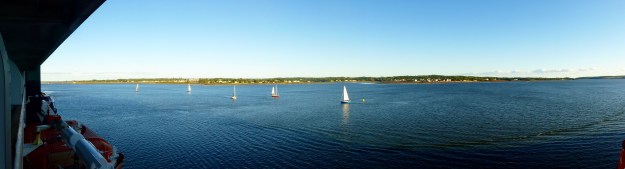
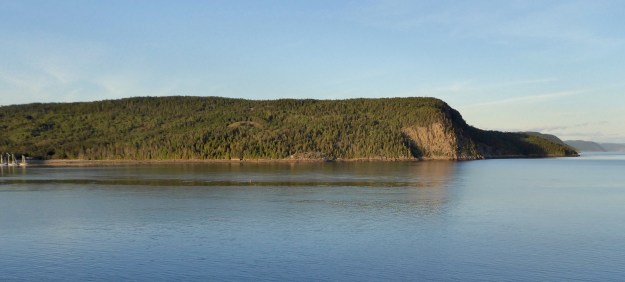
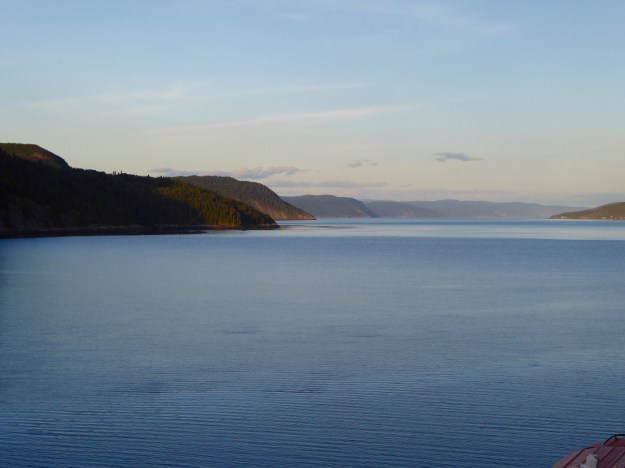
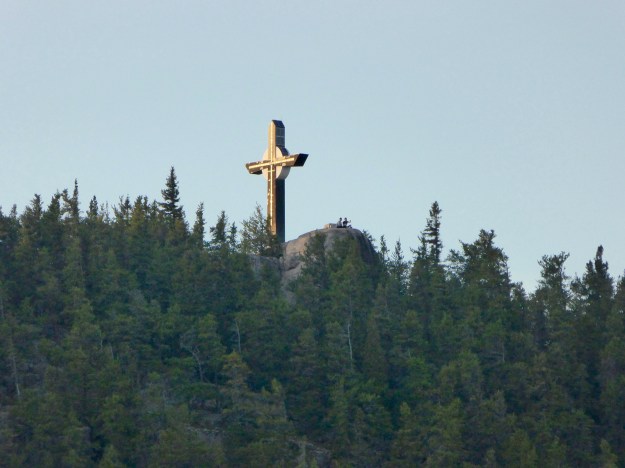
It was then back to the ship and a lovely evening sail down the fjord back towards the Gulf of St Lawrence. I include the obligatory seabird photo, some, what I hope, are Canadian geese, a seaplane, another cruise liner and a guy in a canoe.

And here is the fjord!

P1020911P1020914P1020922P1020923

Next stop Quebec!