9th to 10th March, 2017
Ok, here we are again, with the remains of our day in Mumbai.
On we went, this time to the Mahalakshmi dhobi ghats, the famous and iconic open-air laundry of Mumbai, a miracle of organisation. Laundry is collected from all over Mumbai, tagged, soaped, soaked in caustic soda and pounded and thrashed at the flogging stones by the dhobis. The next day, after being hung out to dry, they are ironed with charcoal irons, folded in newspaper and tied up with cotton thread and returned whence they came, allegedly with few errors. Fabulous colours!
I should just mention another organisational miracle of Mumbai, which admittedly we didn’t witnes, that of the dabbawalas, officially the Nutan Mumbai Tiffin Box Suppliers Charity Trust. First established in 1890, every day they deliver home-cooked food from about 175,000 suburban kitchens to offices in the downtown area. Each lunch is prepared by a devoted wife or mother while husband or son is being crushed on the train. The lunch is packed in the tiffin box or dabba. A collecting dabbawala, usually on bicycle, collects dabbas either from a worker’s home or from the dabba makers. As many of the carriers are of limited literacy (the average literacy of dabbawalas is that of 8th grade), the dabbas (boxes) have some sort of distinguishing mark on them, such as a colour or group of symbols. The dabbawala then takes them to a sorting place, where he and other collecting dabbawalas sort the lunch boxes into groups. The grouped boxes are put in the coaches of trains, with markings to identify the destination of the box (usually there is a designated car for the boxes). The markings include the railway station to unload the boxes and the destination building delivery address. I will admit to cheating here as I have had to filch the photos from the internet, but it should give you an idea of what the operation looks like.
At each station, boxes are handed over to a local dabbawala, who delivers them. The empty boxes are collected after lunch or the next day and sent back to the respective houses. The dabbawalas also allow for delivery requests by SMS. Forbes magazine was rather erroneously attributed as giving the operation a 6-Sigma performance rating which they reserve for companies who attain a 99.9 percentage level of correctness which means only 1 box in 6 million goes astray. However this was an extrapolation of a comment from the dabbawalas’ boss that only one lunch in two months of deliveries goes astray, so you may want to take the statistics with a pinch of salt. Impressive nonetheless.

May 16, 2007, Mumbai India. Dabbawallas wind up their day and are driving back home from Churchgate Station. CREDIT: Fawzan Husain for The New York Times
It was now time for a very different tour, that of the ‘slums’, specifically the Dharavi slum. Note that the tour company asks that we don’t take photos in respect of the people who live there, but they do allow you to download some they took, so I will scatter them about the rest of this part. They give a bit of an impression, though they do not include the rubbish, open sewer and dodgy working safety practices!
I have put ‘slum’ in inverted commas (and I have just done it again) as it needs a bit of definition. It is certainly the term used in Mumbai, but even that is differentiated into legal and illegal slums. Dharavi is legal and is old, going back to the 19th century. Wikipedia defines slums as “A slum is a heavily populated urban informal settlement characterized by substandard housing and squalor. While slums differ in size and other characteristics, most lack reliable sanitation services, supply of clean water, reliable electricity, law enforcement and other basic services. Slum residences vary from shanty houses to professionally built dwellings that because of poor-quality construction or provision of services have deteriorated into slums.”
By this definition Dharavi is not a slum and Rakesh, Val and I discussed at some length what it could be called. We agreed it could be compared to a favella though without the crime levels, but in the end we’d agreed it is simply a neighbourhood, though I shall use the term slum for simplicity. In this case, a very busy, productive neighbourhood with an estimated annual turnover of between $500m to $1bn. It is one of the most crowded slums in the world with between 300,000 to 1 million people crammed into its 200 hectares (1,500 to 5,000 per hectare). By comparison, London has about 53 people per hectare (assuming my maths is correct in converting 5,300 per sq km – corrections welcomed).
Much of the industry is based on recycling plastic with a vast network bringing in sackloads of plastic bottles, car bumpers (makes you wonder a bit where they get them!), computer casing and anything else they can lay their hands on, which is sawn up, chopped into small pellets, dyed, dried on the roof and sold to manufacturers of plastic goods that are not used for food (or so we were assured).
In addition there are leather workers, though not tanneries and pottery makers (including kilns in the middle of the residential area) and a number of other industries.
In the absence of my own photos, I will though try to describe what we saw. The slum is divided into the industrial side and the residential one, though the latter also has some industry. Most of the ‘streets’ were effectively narrow alleyways where two people could barely walk past each other. There is electricity and water (you can see the cables and pipes everywhere), but sewage seems to be a problem as evidenced by a very pungent open sewer that takes waste down to the river. There was the usual amount of rubbish everywhere, but no more than you might find anywhere else in India. The people were friendly, immaculately turned out, especially the children who delighted in greeting us and high fiving (though rather low down ones!) and we saw no sign of begging.
The health and safety inspectors would have a field day, but that is India all over, sadly. All in all a fascinating, sobering and positive experience. There were many good things, but also some aspects that obviously could be a lot better. You do feel here, as in much of India, that with a bit of collective local commitment, much could be done to improve the communal parts of their lives. For example, they will sweep their own doorstep, but no one will sweep the street, where is is presumably seen as okay to leave your rubbish (and I am not just talking litter). What you have to get your head around is that people do not seem to mind enough to do something about it together and the government does not seem well enough organised or committed to step in. It is worth remembering though that many people do actually choose to live here – rent is reasonable, there is a sense of community and for many, it is home.
We had a quick lunch and then a drive to the other end of the city and the social scale, to Malabar Hill, where the British originally set up their leafy suburb. Rakesh showed us a Jain temple which was impressively well-painted and maintained unlike most of the city. Sadly, I think this post is getting a bit lengthy, so I will leave it up to you to do the research on Jainism. They make up a very small part of the Indian religious community, but have a very big impact. We saw some very old Jain temples in Rajasthan last year.
We also visited the Banganga tank, a large tank filled by a spring (said to be from the sacred Ganges, though that would be geographically impressive!) created when Rama shot an arrow into the spot. It was in a bit of a sad state and not as beautiful as what we had seen in Rajasthan, but rather pleasing to see in the middle of busy Mumbai.
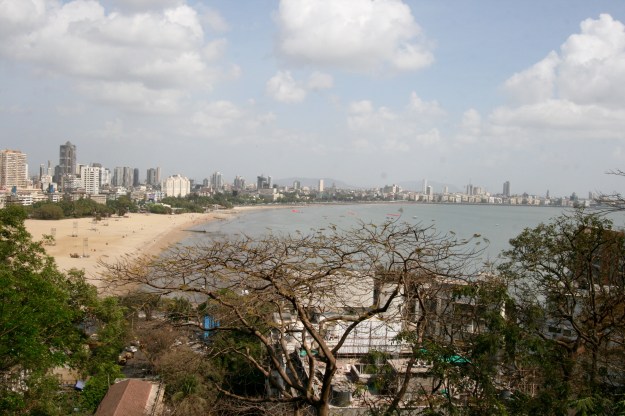
We had a quick walk around what are called the Hanging Gardens, due to their altitude above the city which had a great view of the city, but they could have benefited from a lesson or two from some Vietnamese municipal gardeners.
We also stoped by what is called the $2bn house, though ‘house’ is certainly a misnomer for what is a 27 storey skyscraper and some say it is worth ‘only’ $1 billion. It was erected and is owned by Mukesh Ambani, the owner of Reliance industries and reputably the richest person in India. It employs 600 people and has about 600 rooms and is where he and his family live in the 27 floors (very high ceilings mean that it would normally be 60 floors). It was much opposed on a number of grounds, but oddly he seemed to have managed to persuade the authorities to allow it. It probably helps to be the nation’s richest man. It also has three helipads…. Not, in my opinion, an attractive building and many see it as grotesque spending in a country where there are still so many living in slums. He can’t be too pleased that another taller building is being erected behind his that will overlook it! It is the buildings on the right in the photos below.
Our last stop was a house, Mani Bhavan, which houses the Mahatma Gandhi Museum as it was his base from 1917 t 1934. Fascinating photos and other mementos, including a letter to Hitler suggesting world peace. His simple sitting room/bedroom is also preserved and there are about 25 cases holding a sort of puppet version of famous moments in his life in a sort of tableau. Lots of pictures with many of his writings hang on the wall giving you a taste to discover more about him and his philosophy.
We drove down the famous Marine Drive, past Chowpatty Beach (you do NOT swim in the sea in Mumbai!) and past the gymkhanas, another venue for endless cricket matches. We stopped for a quick photo of the ‘floating’ mausoleum of the Muslim saint and Afghan mystic, Haji Ali Bukhari, which is connected to the mainland by a narrow causeway that is submerged at high tide.
A few few more snaps of once-wonderful buildings from the car, including what I think is the General Post Office, which actually looked in good repair.
We ventured out for a meal in the evening, though only across the road from the hotel and an ‘Italian’ restaurant at that (we have a policy of not eating anything too exotic before a flight, just in case!). A decent enough pizza, though weirdly our drinks, which were not too complicated, arrived about 10 minutes after we had actually finished eating. There was quite a lot of bustle on the surrounding streets due, we discovered the next day, to local state elections, but we retired to our air-conditioned comfort and sleep.
Impressions of Mumbai? I thought the city would have more traffic, but everything seemed to keep moving albeit in the usual Indian laisser-faire manner of finding the tiniest gap and honking at every opportunity. The buildings range from stately Raj fare, through high rise to shanty towns/slums, but almost all of it in some state of disrepair. External paint sales people would never make their fortune in Mumbai. The sad thing is that many fine buildings are just slowly falling to pieces and will probably be demolished and replaced by something in concrete. I would love to come back and explore it thoroughly as there is much more to see. It is certainly NOT dull!
Our adventures continue in Goa!
More soon.


 John & Val's World Travels