Monthly Archives: March 2017

More from Goa – Big Waterfalls and Old Houses

26th to 29th March, 2017

We have been filling up our last week with this and that – the table tennis table has been restored, Val has seriously taken to darts (though progress seems distinctly slow – I blame the darts) and there is still the pool and the pool table. We are fit and healthy, enjoying ourselves and making the most of our last week.

We have been on another trip with Izzy, our friendly taxi driver, this time heading due east to the Dudhsagar waterfalls on the Goa-Karnataka border. They are some of the highest in India, falling down the Western Ghats with the name translating as ‘sea of milk’, which, as I hope you will agree from the photos, is very apposite.

It was an early 7.30 start (I know, but that is early for us!) for reasons that will become apparent soon. It is about an hour’s drive from where we are staying to Colem which is the  staging post for phase two of ‘getting to the falls’. A couple of on-the-way photos….

We arrived to what seemed to be total chaos in rather typical Indian fashion, but also in typical Indian fashion were sort of pounced on by a few gentlemen who immediately took us in hand, guiding us to the ‘controller of jeeps’ who relieved us of 400 rupees each for the 45 minute jeep journey to the falls, then some more for the statutory life jackets (you can swim at the falls and there have been drowning in the past) and a few more rupees for the use of a camera. All this to accompanying shouts and noise and people dashing about. We were then squeezed into the back of the Bolero jeep along with a freelance guide who sort of attached himself to us. It was an interesting journey as we bumped over the dusty road, forded three rivers and shook until it felt as though we had gone 10 rounds with Mohammed Ali! There are supposedly over 430 jeeps ready to transport you and a family of Russians up the only, narrow road. Luckily, having got there reasonably early, we got away quite easily, arriving before most of the other 429 jeeps. Actually, at this time of year there are probably a mere 300 operating on a daily basis, in strict unionised rotation, but we still did well to get there early.

There is a 10 minute walk to the falls, helped by our ‘guide’, which was quite scenic in its own right, until we arrived at the star attraction, not least the great sign on the ladies’ “changing room”.

And then we came across the waterfall. It is hard to capture the height of it with the wide-angle lens, but I hope you get the idea. It is 610 metres high and has a very exciting railway bridge that crosses it about halfway up – complete with train at one point! I would point out that it is considerably more impressive after the monsoon, but it is still reasonably awe-inspiring all the same.

Of course, being a hot day, I had to have a swim. Val was on camera duty and did an excellent job of me inching my way over some rather slippery rocks until I was able to strike out for the deluge itself – after scaring off the quite large resident fish and discovering there was a rock halfway on the way there on which you can happily bash yourself. My apologies for the following full-frontal footage! I have spared you some of the more embarrassing photos, trust me!

Very refreshing! The place was filling up pretty quickly and there was a growl of Russian across the water. Still time for a few poses…….

The sight that greeted us back at the jeep park was of jeep overload. Getting out took a bit of work, but we were eventually on our way. As Val and I got to the jeep before our Russian fellow passengers, I sat in the front (where the father Russian had sat on the way up) though Val generously resumed her seat in the very back so that the mother and two girls could sit together. This arrangement did not go down very well with Papa Russian who unceremoniously tried to pass Val’s backpack all the way to me in the front without even asking. Val NOT impressed and said something very terse and pithy about manners and courtesy, which was undoubtedly not understood by the recipient. Still, it had to be done! Cutish monkey with baby posing for photos which despite being expressly asked not to, was being fed by the general public. We bumped our way back to Colem where it was possibly more frenetic than ever and said goodbye to Rams, our spontaneous guide.

We had one other destination, which was a very old and rather magnificent house that is open to the public. This is actually two houses, though one building, called the Braganza-Perrreira/Menezes-Braganza house. It is divided into two separate wings each occupied by several generations of the original family who built the house in the 1500s each branch descended from two brothers who each lived in each wing. The oldest part is 450 years old and the newest about 300 and chock full of antiques. We were invited to the right-hand side first by the matriarch, Judith and given the tour. Very nice, but photos are verboten, so I can’t show you what it looks like (try online?). There is no entrance fee, but you are expected to make a donation. I was ‘amused’ that my original donation was turned down and it was suggested that I need to try again!

We thought we would try the left-hand side too, so rang the bell and were greeted by another matriarch who advised us she was 14th generation (well, she married into it) and that the house was home to the 16th generation. I was allowed to take some photos including the ballroom and chapel, wherein lies the diamond-encrusted toenail of St Francis Xavier no less. A fascinating insight into a world long gone now.

Another great day out, though Izzy our trusty taxi driver managed to include a temple as well on the way back. Rather fitting considering how many we have fitted in on our tour. And if you have ever wondered what a cashew looks like, there is a picture below. The nut is the bit on the right sticking out of the fruit.

Ok, I am going to post this now. We are nearly at the end of our wonderful travels, though I have one more adventure to tell you about from Goa and then it is off to Dubai for three nights and then home to what I hope will be sunny and warm England.

Panjim and Old Goa – A Step Back in Time

18th to 25th March, 2017

Well, good news, we are still here in Goa and still having a wonderful time. Last time we were together we had been for our statutory trip to a market and you got an insight into the wild time we are having. Nothing much has changed, you will be glad to hear. We are still playing table tennis (though shock horror, the table is out of commission today – Val is almost having withdrawals) and I even won the afternoon competition. Ok, it was only Val, me and a couple of kids, but it did get me a free cocktail. Unfortunately we have been pipped twice in the pub quiz –  next week! Val has also discovered pool and is determined to improve to the extent that she disappears at times to put in a bit of extra practice. We have even had a go at darts, though we are so poor that we had to abandon one game as neither of us could get a double to finish.

Other than that it is lots of exercise (Val gym, me pool (as in swimming)), relaxing, reading and using this wonderful free time to catch up on things like planning our next trip, doing our cash flow (so we can afford the next trip!) and Parkinson’s stuff An such like. We have now played game 636 of Yahtzee and Val has opened up a lead again of 9. It won’t last long…… (he said, confidently).

We have been sampling the local restaurants one by one. There is plenty of Goan food on offer with many different masala sauces. It is quite useful really as you can really brush up on your knowledge of Indian food and work on the difference between a Rogan Josh, Korma, Chicken Tikka, Tandoori and Biryani or try the different dahls, parathas, naans or roti. Goa is the home of the vindaloo, which comes from the Portuguese, vinho d’alho, literally ‘garlic wine’, originally an extremely hot and sour pork curry.

We had an interesting time last Saturday as we signed up for an evening of Latin Jazz Funk with a live band at the hotel and South American and Mexican buffet. The music was excellent, food good and we met a fascinating lady called Jenepher Bramble who had brought the band leader to Goa from Brazil via Rome. She was born in India, is descended from General Napier of the famous Latin quip ‘peccavi’ ‘I have sinned’, after he captured the city of Sind (gettit?), has lived many years in Rome, but spends some months of the year in Goa in a wonderful old Portuguese house she and her brother (ex Lord Mayor of London) bought and renovated named Quito de Halicarnassus (check it out online). She asked us to come for dinner, but it is sadly some way away and dinner wasn’t going to start until after 9pm. We could have stayed overnight, but it was probably a bit too much, so we declined.

We have had a day out though to the capital of Goa, Panjim (new name Panaji, that no one seems to use) and the old capital, Old Goa. The best news is that Anthony, our taxi driver from our last trip, was not next on the taxi rank. Instead we had Izzy in a very nice, almost new car which he drove at a very good pace and enhanced the trip by being a fount of knowledge on many things Goan. Some interesting sights on the way to Panjim reflecting the Catholic influence of the Portuguese who were here from 1510 when Afonso de Albuquerque captured Panjim fort to 1961 when the Indian government launched ‘Operation Vijay’ in defiance of the UN sending in the troops having lost patience with negotiations with the Portuguese dictator, Salazar, to cede the territory to India. Other religions other than Catholicism having originally been banned by the Portuguese and enforced by the Inquisition (who themselves were banned in 1820), the numbers of Catholics have declined from about two thirds in 1851 to 25% in 2011. However, their representation in churches, chapels and names like de Souza, Perreira, Braganza, d’Mello, and da Silva belies their reduced status.

We were dropped off in an area of the city called Fontainhas where many of the buildings have retained the Portuguese injunction that all buildings must be colour washed after each monsoon. Sadly, even though Goa is a big improvement on all the rest of the bits of India we have seen with regards to building maintenance, many of the rest of Panjim has seen better days. As my guidebook so appositely puts it, most buildings in Fontainhas are ‘in a state of charismatic decay’. I really hope someone describes me like that one day (though not yet).

A few photos, including the local chapel, sadly closed, in which there is an eerily lifelike crucifix which formerly hung in the Palace of the Inquisition in Old Goa. Unusually Christ’s eyes are open – allegedly to inspire fear in those being interrogated! I have also included a photo of what must be a more unusual tree decoration apparently made from bits of plumbing!

We wandered on via the azulejos or Portuguese tiles gallery to the Church of the Immaculate Conception, built in 1541 and to Church Square with a decent park and on to the oldest building, the Secretariat. The latter was originally the summer palace of Goa’s 16th-century Muslim ruler, the Adil Shah and latterly of the state legislature. There is a wonderful statue nearby of Abbé de Faria (1755-1819), a Goan priest who emigrated to France to become one of the world’s first professional hypnotists.

Other than that we did not wander far in the 34 degree heat, but I did snap a few street scenes including the mildly disturbing sign included below (you have to hope that the two institutions are not linked) and the Archbishop’s palace. There is obviously more to Panjim including your standard commercial and retail areas, but we had limited time and energy!

Next on our itinerary was Old Goa or Velha Goa which was the capital until 1843 when the river on which it is situated silted up and the ravages of malaria, plague and cholera epidemics meant the city was virtually abandoned in the 18th century. It had had a population of as many as 200,000 in the 16th century, bigger than London or Paris at that time, but was only 1,500 by the 1750s. Sadly there is nothing left of the old city, but the magnificent churches are still there and are a UNESCO site and a place of pilgrimage for Catholics and Hindus alike specifically to pay homage at the tomb of St. Francis Xavier, about whom, more later.

Our first stop was to a church dedicated to a different St. Francis, that of Assisi, built in 1521 and mistaken by us initially for the cathedral next door. It is a really interesting design and has a mildly ruined or unfinished quality to it that gives it real spiritual quality, helped by a lack of tourists too. The entrance, with its archway was different and the side chapels were beautiful with intricate carvings. I think that the lack of gold everywhere which you can so often find in other examples of this kind, helps give it a more attractive allure.

Wonderful though this had been, it was not the main attraction one of which was almost next door, the Sé (Portuguese for See) aka St. Catherine’s Cathedral. It is larger than any church in Portugal, took 80 years to build and was consecrated in 1640. It only has one tower now, which houses the Golden Bell whose tolling announced the start of the gruesome auto da fés in the square outside when heretics were tortured and burned at the stake. The interior is designed to shock and awe and does the job well, with the massive gilded main altar and 15 side chapels dedicated among others to Our Ladies of Hope, Anguish and Three Needs (?). Not sure what the last ones are, but I am sure they all came in useful if you felt the Inquisition breathing down your neck! The chapel with the ornate carved screen is that of the Miraculous Cross, found in a Goan village on which Christ was said to have appeared.

Not much more than 200 yards away is the big draw for Goans, Catholics and many Indians, the Bom (as in Good or Holy) Jesus basilica, holding as it does, the remains of St. Francis Xavier, the ‘Apostle of the Indies’, who was born in 1506 in Navarre, was ordained in 1537 and was a founder member of the Society of Jesus or Jesuits having been recruited by St. Ignatius Loyola. He was despatched to Goa in 1541 to smarten them up a bit and worked throughout southern India, Sri Lanka, Malacca in Malaysia and, with limited success, in China and Japan. He died near China in 1552 where he was buried, then removed to Malacca for a year and then reexhumed and reburied here in Goa. Luckily for all concerned, his body had miraculously failed to decompose, though it has never really rested in peace as chunks have been removed over the years by relic hunters. In 1641 the right arm was dispatched to the Pope in Rome (where it allegedly wrote its name on paper), a hand was sent to Japan (but only made it to Macao) and parts of his intestines to Southeast Asia. The most gruesome mutilation occurred in 1634 when a Portuguese noblewoman, Dona Isabel de Caron, in a moment of spiritual ecstasy, bit off one of Francis’s toes. So much blood spurted into her mouth that it led a trail to her house and she was discovered. Nice! His now very decrepit body is exposed every ten years for pilgrims to view and touch it, the last time being in 2014.

Anyway, first up here is the exterior of the front of the cathedral and a side view with the church of St. Francis of Assisi on the left and a nice sign of slogans of cultural heritage and a very leaning tree.

Next the exterior of the basilica, complete with a posing lady having her photo taken outside, with Val trying to shield herself from the sun and heat with her scarf!

The interior is fairly standard, but suitably impressive.

And then there is the tomb itself, a gift of the Medici, Cosimo III, in 1696 and a rather gruesome cross and his original casket. His body is in the glass casket on the top of the altar in the photo below.

And so after a warm but rewarding day we headed back to the air-conditioned comfort of our resort. A very interesting view of a very different part of India.

More soon!

On the Go in Goa (well, a little bit)

11th to 17th March, 2017

Well, here we are in Goa. Nothing to report on the flight, though the taxi we procured at Goa Airport was a bit of an experience as it seems we have met India’s answer to Lewis Hamilton! The roads are quite narrow in places too, but with surprisingly quick acceleration, thankfully good brakes and a horn that was in the finest of fettle, we made it to our next stop in South Goa in record time. We did get a chance to have a look at the local area, though it was often flashing by in a blur or our attention was more aimed towards what was in front, beside and behind us. What we did see was a pleasant surprise as most of the houses were painted and in very bright colours at that. It seems the Portuguese had a policy that all houses had to be colour-washed after each monsoon and the habit seemed to have stuck for the most part. There are still plenty of old Portuguese-style houses and we plan to visit some during our stay.

We are staying at the Karma Royal Haathi Mahal resort in Cavelossim, which is about 45 minutes drive from the capital Panaji (depending who is driving!). Goa is one of the smallest states in India with only 1.5 million people, but the one with the highest GDP per capita largely due to the 2 million plus tourists each year, both foreign and local. Our resort reflects this with a mixture of mostly Brits and Indians with a sprinkling of Russians as Goa is so popular with the latter that most signs are in English and Cyrillic script.

We have a nice apartment, though it is looking its age some what, but there is a nice pool, restaurant and TWO table tennis tables and a pub! I have yet to take any photos of the resort, but here are some of the apartment to keep you going.

So far we have filled our days with a bit of breakfast, some table tennis, some swimming for me and the gym for Val, lying by the pool, playing Yahtzee (Val has opened up a 7 point lead) and reading. We usually skip lunch and then wander out for supper at one of the restaurants outside the resort. So far we have tried a couple of small local ones, an Italian (bad restaurant, as Donald T would say), a Greek (good) and a big all-singing-all-dancing one that was good and has live music every now and then. They even ferry you to their beach shack some evenings, which we sort of enjoyed. I say sort of as the location was nice and the food good, but the music was booming and we had fallen in with another couple on the way there in the back of the jeep and agreed to eat together. They (Lester and Linda) were perfectly nice, but we experienced what we are now convinced is a particularly British phenomenon whereby the couple you are chatting with never actually ask you any questions. I honestly think we would have had the meal in silence if Val and I had not kept up a stream of questions. For our part, we know that they live in Weston-super-Mare (though Lester was originally from Birmingham), they were married in 1974, they have a son and a daughter, the former having step children in their late teens, the latter having 3 children, Lester works in. primary school helping with maintenance and IT, Linda in a home for the elderly, they have three websites, one for them, one for their camper van and one for Lester’s model railway. I could also tell you at least six destinations of previous holidays. I could go on! All they know about us is that I once worked in Papua New Guinea. Not one single question about us – why is that? It baffles us.

It has not all been hanging round the pool. We did walk down to the beach and had a drink at one of the many shacks. Goa has a policy of not allowing hotels on the beaches. Nice beach, though swimming can be a bit dangerous. We were bemused that there were red flags to denote where not to swim, but there were still people swimming there. Val asked a lifeguard about them and he just sort of shrugged. I presume that either the flags are placed randomly as a gesture to health and safety or they employ the Darwin Award philosophy that if you are stupid enough to swim there, then it is no bad thing if you remove yourself from the gene pool through your own stupidity.

We have been on one outing so far, to the Anjuna Market, almost 2 hours north of where we are staying. The hotel will call up a taxi off the rank in strict Hobson’s Choice method since the cabbies operate a unionised system with fixed prices for wherever you want to go, though it depends I find you want a small or big taxi. Being only two of us, we went for the small version and so up the ramp to the hotel lobby comes the smallest taxi you are likely to see this side of Lilliput. It was a bit bigger than the old Fiat 600 and at the wheel was 65 year old Anthony. For a moment it looked as though we would not actually leave the hotel as he kept stalling in an attempt to gain the tarmac of the road. Finally we were off and it was nice and steady mostly, though there were certainly some fellow users of the road who incurred his wrath – women bikers, bikers who rode two abreast chatting to each other, speed bumps (not that he always spotted them in time), buses, cars and virtually most of the rest. He was a great grumbler too who basically felt that life was much better under the Portuguese and it was all downhill from when they left (or were kicked out) in 1962. Val tried to snooze and I decided I had better just make agreeing noises and make sure he stayed awake and relatively calm. How Val could sleep when he was on the horn every 5 seconds, I will never know. Especially when he decided that someone needed a particularly long blast! Never dull.

The market was excellent with sellers from all over India. It covers a very large area, but only operates in a Wednesday.

You could have filled a suitcase (indeed we saw someone doing so) with goodies and still not have finished. Of course haggling is demanded -and demanding – aiming to end up at anything as low as 40% of the starting price or better! A few photos of what was on offer….. so much colour.

And then there are the people, both Indian and from abroad. I love the group I snapped on the road with the sign Future Hippie behind them.

And then there were all those things that needed the arty touch…..

And lastly, a couple of snaps of Val. The background wall was such a strong colour I couldn’t resist. I would add that we had just spent a hot session at the market including buying the necklace she is wearing.

Ok, that’s all folks!

More soon from sunny Goa!

Mumbai Magic! Part Two.

9th to 10th March, 2017

Ok, here we are again, with the remains of our day in Mumbai.

On we went, this time to the Mahalakshmi dhobi ghats, the famous and iconic open-air laundry of Mumbai, a miracle of organisation. Laundry is collected from all over Mumbai, tagged, soaped, soaked in caustic soda and pounded and thrashed at the flogging stones by the dhobis. The next day, after being hung out to dry, they are ironed with charcoal irons, folded in newspaper and tied up with cotton thread and returned whence they came, allegedly with few errors. Fabulous colours!

I should just mention another organisational miracle of Mumbai, which admittedly we didn’t witnes, that of the dabbawalas, officially the Nutan Mumbai Tiffin Box Suppliers Charity Trust. First established in 1890, every day they deliver home-cooked food from about 175,000 suburban kitchens to offices in the downtown area. Each lunch is prepared by a devoted wife or mother while husband or son is being crushed on the train. The lunch is packed in the tiffin box or dabba. A collecting dabbawala, usually on bicycle, collects dabbas either from a worker’s home or from the dabba makers. As many of the carriers are of limited literacy (the average literacy of dabbawalas is that of 8th grade), the dabbas (boxes) have some sort of distinguishing mark on them, such as a colour or group of symbols. The dabbawala then takes them to a sorting place, where he and other collecting dabbawalas sort the lunch boxes into groups. The grouped boxes are put in the coaches of trains, with markings to identify the destination of the box (usually there is a designated car for the boxes). The markings include the railway station to unload the boxes and the destination building delivery address. I will admit to cheating here as I have had to filch the photos from the internet, but it should give you an idea of what the operation looks like.

At each station, boxes are handed over to a local dabbawala, who delivers them. The empty boxes are collected after lunch or the next day and sent back to the respective houses. The dabbawalas also allow for delivery requests by SMS. Forbes magazine was rather erroneously attributed as giving the operation a 6-Sigma performance rating which they reserve for companies who attain a 99.9 percentage level of correctness which means only 1 box in 6 million goes astray. However this was an extrapolation of a comment from the dabbawalas’ boss that only one lunch in two months of deliveries goes astray, so you may want to take the statistics with a pinch of salt. Impressive nonetheless.

It was now time for a very different tour, that of the ‘slums’, specifically the Dharavi slum. Note that the tour company asks that we don’t take photos in respect of the people who live there, but they do allow you to download some they took, so I will scatter them about the rest of this part. They give a bit of an impression, though they do not include the rubbish, open sewer and dodgy working safety practices!

I have put ‘slum’ in inverted commas (and I have just done it again) as it needs a bit of definition. It is certainly the term used in Mumbai, but even that is differentiated into legal and illegal slums. Dharavi is legal and is old, going back to the 19th century. Wikipedia defines slums as “A slum is a heavily populated urban informal settlement characterized by substandard housing and squalor. While slums differ in size and other characteristics, most lack reliable sanitation services, supply of clean water, reliable electricity, law enforcement and other basic services. Slum residences vary from shanty houses to professionally built dwellings that because of poor-quality construction or provision of services have deteriorated into slums.”

By this definition Dharavi is not a slum and Rakesh, Val and I discussed at some length what it could be called. We agreed it could be compared to a favella though without the crime levels, but in the end we’d agreed it is simply a neighbourhood, though I shall use the term slum for simplicity. In this case, a very busy, productive neighbourhood with an estimated annual turnover of between $500m to $1bn. It is one of the most crowded slums in the world with between 300,000 to 1 million people crammed into its 200 hectares (1,500 to 5,000 per hectare). By comparison, London has about 53 people per hectare (assuming my maths is correct in converting 5,300 per sq km – corrections welcomed).

Much of the industry is based on recycling plastic with a vast network bringing in sackloads of plastic bottles, car bumpers (makes you wonder a bit where they get them!), computer casing and anything else they can lay their hands on, which is sawn up, chopped into small pellets, dyed, dried on the roof and sold to manufacturers of plastic goods that are not used for food (or so we were assured).

In addition there are leather workers, though not tanneries and pottery makers (including kilns in the middle of the residential area) and a number of other industries.

In the absence of my own photos, I will though try to describe what we saw. The slum is divided into the industrial side and the residential one, though the latter also has some industry. Most of the ‘streets’ were effectively narrow alleyways where two people could barely walk past each other. There is electricity and water (you can see the cables and pipes everywhere), but sewage seems to be a problem as evidenced by a very pungent open sewer that takes waste down to the river. There was the usual amount of rubbish everywhere, but no more than you might find anywhere else in India. The people were friendly, immaculately turned out, especially the children who delighted in greeting us and high fiving (though rather low down ones!) and we saw no sign of begging.

The health and safety inspectors would have a field day, but that is India all over, sadly. All in all a fascinating, sobering and positive experience. There were many good things, but also some aspects that obviously could be a lot better. You do feel here, as in much of India, that with a bit of collective local commitment, much could be done to improve the communal parts of their lives. For example, they will sweep their own doorstep, but no one will sweep the street, where is is presumably seen as okay to leave your rubbish (and I am not just talking litter). What you have to get your head around is that people do not seem to mind enough to do something about it together and the government does not seem well enough organised or committed to step in. It is worth remembering though that many people do actually choose to live here – rent is reasonable, there is a sense of community and for many, it is home.

We had a quick lunch and then a drive to the other end of the city and the social scale, to Malabar Hill, where the British originally set up their leafy suburb. Rakesh showed us a Jain temple which was impressively well-painted and maintained unlike most of the city. Sadly, I think this post is getting a bit lengthy, so I will leave it up to you to do the research on Jainism. They make up a very small part of the Indian religious community, but have a very big impact. We saw some very old Jain temples in Rajasthan last year.

We also visited the Banganga tank, a large tank filled by a spring (said to be from the sacred Ganges, though that would be geographically impressive!) created when Rama shot an arrow into the spot. It was in a bit of a sad state and not as beautiful as what we had seen in Rajasthan, but rather pleasing to see in the middle of busy Mumbai.

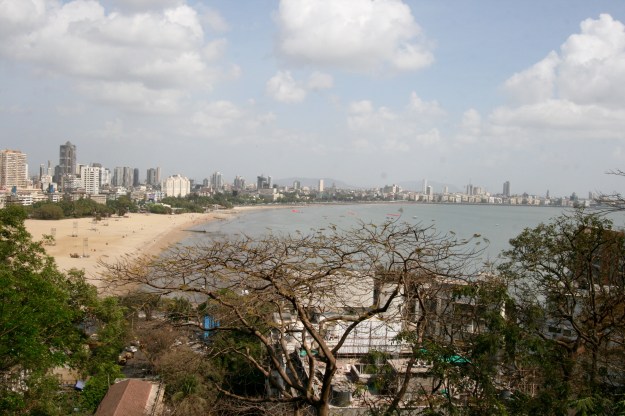
We had a quick walk around what are called the Hanging Gardens, due to their altitude above the city which had a great view of the city, but they could have benefited from a lesson or two from some Vietnamese municipal gardeners.

IMG_4689

We also stoped by what is called the $2bn house, though ‘house’ is certainly a misnomer for what is a 27 storey skyscraper and some say it is worth ‘only’ $1 billion. It was erected and is owned by Mukesh Ambani, the owner of Reliance industries and reputably the richest person in India. It employs 600 people and has about 600 rooms and is where he and his family live in the 27 floors (very high ceilings mean that it would normally be 60 floors). It was much opposed on a number of grounds, but oddly he  seemed to have managed to persuade the authorities to allow it. It probably helps to be the nation’s richest man. It also has three helipads…. Not, in my opinion, an attractive building and many see it as grotesque spending in a country where there are still so many living in slums. He can’t be too pleased that another taller building is being erected behind his that will overlook it! It is the buildings on the right in the photos below.

Our last stop was a house, Mani Bhavan, which houses the Mahatma Gandhi Museum as it was his base from 1917 t 1934. Fascinating photos and other mementos, including a letter to Hitler suggesting world peace. His simple sitting room/bedroom is also preserved and there are about 25 cases holding a sort of puppet version of famous moments in his life in a sort of tableau. Lots of pictures with many of his writings hang on the wall giving you a taste to discover more about him and his philosophy.

We drove down the famous Marine Drive, past Chowpatty Beach (you do NOT swim in the sea in Mumbai!) and past the gymkhanas, another venue for endless cricket matches. We stopped for a quick photo of the ‘floating’ mausoleum of the Muslim saint and Afghan mystic, Haji Ali Bukhari, which is connected to the mainland by a narrow causeway that is submerged at high tide.

A few few more snaps of once-wonderful buildings from the car, including what I think is the General Post Office, which actually looked in good repair.

We ventured out for a meal in the evening, though only across the road from the hotel and an ‘Italian’ restaurant at that (we have a policy of not eating anything too exotic before a flight, just in case!). A decent enough pizza, though weirdly our drinks, which were not too complicated, arrived about 10 minutes after we had actually finished eating. There was quite a lot of bustle on the surrounding streets due, we discovered the next day, to local state elections, but we retired to our air-conditioned comfort and sleep.

Impressions of Mumbai? I thought the city would have more traffic, but everything seemed to keep moving albeit in the usual Indian laisser-faire manner of finding the tiniest gap and honking at every opportunity. The buildings range from stately Raj fare, through high rise to shanty towns/slums, but almost all of it in some state of disrepair. External paint sales people would never make their fortune in Mumbai. The sad thing is that many fine buildings are just slowly falling to pieces and will probably be demolished and replaced by something in concrete. I would love to come back and explore it thoroughly as there is much more to see. It is certainly NOT dull!

Our adventures continue in Goa!

More soon.

Mumbai Magic! Part One.

9th to 10th March, 2017

Apparently this is my 100th post! And I am splitting it in two as it seems to have grown into a short travel book. So here is Part One.

We had a pretty uneventful trip from Bali to Mumbai, though Malaysia Airlines does not give you a great deal of legroom and, considering the amount of space you get in the way of elbow room, serving spaghetti was not the best idea! Anyway, we had an ok leg to KL followed by about 4 hours in transit and then the nearly 5 hour flight to Mumbai. This meant we arrived at our hotel at the equivalent of about 3am Bali time (though about 1230am Mumbai time). At least I caught up with The Accountant in the movie channel on the plane, which proved quite diverting, but we were quite tired by the time we got to sleep at something like 1.30am.

Now, I had booked us for a day tour of Mumbai, which was looking a bit daunting after not much sleep, but we were up and ready by 0830 when our guide Rakesh from Reality Tours picked us up. Reality are an unusual tour company as 80% of their profits go to help children in the slum areas, where they run a primary school, girls football academy, cricket team and more. This was obviously an attraction to go with them, but also, they provide a tour of the slum area called Dharavi, which sounded like it would be educational at the very least.

“Wait a minute!”, I hear you cry, “I thought you just said that you had checked into a new hotel. WHERE ARE THE ROOM PHOTOS???” I am SOOO sorry, here you go (and I hope you are impressed considering the time of night we arrived in said room!). It is the Residency Hotel in the Fort area of town, nice and central, reasonably priced and ok for a couple of nights. I like the fact that they give you a complimentary automated foot massage in the lobby, though you are warned to take your shoes off first!

Ok, where was I? Oh yes, the tour. Rakesh was superb, chatty and knowledgeable and passionate about what he is doing. Before we commenced the slum tour, we drove to a few of the famous landmarks of this fairly ancient city, the land on which it stands originally being 7 islands ceded to the Portuguese in 1534. It was then passed to the English as part of Catherine of Braganza’s dowry when she married Charles II in 1661 and it has effectively thrived from there on in especially once the East India Company leased it and it is now the financial and commercial centre of India – and, of course, the home of Bollywood! It is also home to some 16 million people.

The first attraction we saw was possibly the most famous, the Gateway of India, built in 1924 to commemorate the visit of King George V and Queen Mary in 1911 and designed by George Wittet. The original idea was that P&O liners would pull up alongside and deposit their passengers in front, but now it is a bit of a ferry terminal, but it is still very impressive and a big attraction among local tourists.

I was busy trying to get the best angle, when Val became our star for the day and modelled for a family with their less-than-impressed son. The large building in the photo below is the Taj Mahal Palace and Tower Hotel, THE hotel in town, built by the original Mr Tata, a Parsi businessman who had been denied access to the ‘whites only’ hotel of choice at the time, Watson’s, which, in a twist of fate, is now a crumbling pile in danger of complete demolition. Parsis are Zoroastrians who originally fled from what is now Iran, but was then Persia in the face of Arab invasion between the 8th and 10th centuries AD. They were (are?) very influential in Mumbai especially and have contributed in wide fields of endeavour way beyond their numbers, not least through a core tenet of their religion, charity. I can recommend a quick look at them in Wikipedia and also about Zoroastrian practices. For example we passed on our tour the Towers of Silence. This where the Parsis bring their dead. Since they believe strongly that earth, water and fire are sacred and should not be contaminated by the dead, they place the corpse on the top of the pillar where the flesh is eaten by vultures. Once done, the sun-dried bones are swept into the central cylinder of the pillar and placed in an ossuary. However, they have a modern-day problem in that there are no more vultures, who have fallen victim to farming practices of feeding cattle antibiotics and diclofenac, both of which are harmful to the birds (you wouldn’t think anything a vulture ate could harm them!). The bodies now take longer to decompose which is annoying the neighbours so they are trying out something to do with solar panels and are thinking of breeding vultures to do the job. Problems, problems.

Back to the Taj, you may also remember that the Taj was the target of 10 Muslim extremists who landed from the sea in 2008 and attacked not only the Taj, but 9 other sites as well, eventually killing 166 people over a 4 day period. Indeed, the Gateway itself made the headlines in 2005 when a car bomb killed 107 people.

Next stop was the Oval Maidan, basically a large open area home to innumerable cricket matches at every hour of the day. There were a few informal ones happening even when we visited early in the day.

Mumbai abounds with sturdy British Raj architecture in a variety of styles usually combined into the same building. Next to the maidan you can find the old Secretariat, described in 1903 as “a massive pile whose main features have been brought from Venice, but all the beauty vanished in transshipment” and the University, established in 1857 and designed in England by Gilbert Scott. I couldn’t get a photo of Flora Fountain, now renamed Hutatma Chowk or Martyrs’ Square. It was originally erected to commemorate Sir Bartle Frere in 1869. My guidebook, as ever, is acerbic in its comment: “It is hard to see quite why they bothered – the Raj architecture expert, Philip Davies, was not being unkind when he said, ‘The fountain was designed by a committee, and it shows'”. I managed to snap some lovely ladies either on their way to or from market too and Prashant, our driver, standing next to his chariot!

One of the highlights of any architecture tour of Mumbai is the UNESCO World Heritage Site that is Chhatrapati Shivaji Terminus aka (and still very much known as) Victoria Terminus or VT. The travel journalist, James Cameron, succinctly described it as “Victorian-Gothic-Saracenic-Italianate-Oriental-St Pancras-Baroque”, which pretty much covers it. The sculptures that festoon the exterior were executed at Bombay Art School by the Indian students of John Lockwood Kipling, Rudyard’s father.

The train is, of course, the main commuting choice and is teeming with people. We were there at the end of rush hour, but still had to be careful not to be caught up in the rush and carried off to some unknown destination. The last estimate for the usage of the suburban network is a daily ridership of 7.585 million or 2.64 billion annually, one of the largest in the world. It is also one of the most crowded. In a 9 carriage train , the official capacity is 1,700, but they usually carry around 4,500, defined as Super-Dense Crush Load of about 16 passengers per square metre – and there is no air-conditioning! Women can travel in ‘ladies first class’ or ‘ladies second class’, where men may not travel. Many passengers hang out the door and fall off or sit on the roof and get electrocuted or try crossing the tracks without using the footbridge resulting in many fatalities. And when I say many, I mean many! Over 36,000 were killed between 2002 and 2012, with another 37,000 injured. 17 people every weekday were killed  in 2008. Things have improved when the railway made improvements (e.g. the train will not move if anyone is on the roof!) in 2011, resulting in a 75% drop in fatalities – but there are still about 2,000 a year and this is just on a suburban network! About 28,000 died in railway-related accidents in the whole of India in 2014 (and about 145,000 on the roads!). The numbers are mind-boggling even when you take into account the huge population.

Ok, time to move on and move on we did, to the market, specifically Crawford Market aka Mahatma Phule Market which is the fresh food and domestic animal market. The usual bustle though special mention must go to the meat section, which I entered and rapidly exited as I forgot to hold my breath and I sneaked a couple of pictures in the pet section surreptitiously as apparently they don’t like photos as they have been accused of poor animal welfare, which sadly was probably right.

There is a wonderful area specially for flowers and particularly those used in religious practices, especially the ubiquitous marigolds. Very atmospheric and photogenic (or, to put it another way, I took a lot of photos!).

We continued North passing through Kamathipura, the red light district, a very sad, sorry-looking area and considered by Rakesh as a decided stain on the city where prostitution is legal, but is mostly indentured labour of trafficked women or girls from the countryside with no other opportunities. There was not much to see at the time of day we went, but my, admittedly old, guidebook suggests as many as 25,000 plying their trade of an evening, though as it was written 10 years ago, these numbers may have declined due to the use of the internet. In 2009 a police report estimated 100,000 prostitutes across Mumbai.

Ok, time to post this. Lots in part two including the tour of the slum and the dhobi gats. More soon!


Bali Bliss Part Three – Temples & Rice Terraces


3rd to 8th March, 2017

We decided that we should get out and about once again and soak up some Balinese culture, so this meant heading more or less straight up the island to see a couple of temples, some rice terraces and maybe some wood carvings.

An early start (for us!) of 0800 saw us head off into the traffic towards our first temple of the day, but not without stopping briefly to snap one of the many magnificent statues that frequent many of the main roundabouts in Bali. They usually seem to represent a god vanquishing some demon or other and are generally huge! This is the one we saw. I think something similar would make the difference on some of our roundabouts at home!

Next to Pura Taman Ayun, a temple (or Pura) thought to have been built in 1634 and encircled by a moat to symbolise the mythological home of the gods, Mount Meru, floating in the cosmic ocean. It is a wonderfully tranquil place with soft red brick  and pale stone all looking suitably ancient, but very well preserved. There was a large covered area with some models of people cock fighting (illegal now we were told, but there seem to be plenty of the birds being bred).

There is then an inner courtyard with its own smaller moat which is inaccessible to the general public except at festival time. There are some two dozen meru or pagodas inside and the three most important ones represent Bali’s holiest mountains, their spot in the temple representing their location on Bali. These are Batukara (11 tiers), Batur (9 because it is smaller than the other two) and Agung (11 again).

Taman means garden and there was a lovely wooded area at the far end, again very tranquil. Balinese temples seem to have eschewed the brashness and over-the-top colour of some Hindu temples you find elsewhere and were certainly a bit of a relief after all that gold of the Buddhist temples and shrines of our earlier travels. Great carvings too… (and a couple of good snaps of Val)…

We had a short break at a fruit market to get a few provisions. I can’t remember what the door was all about, but it was really lovely, so you get that as a bonus…

So, one temple down and two to go – or so we thought. More on that soon. Next was Pura Ulun Danau Bratan, again in a lovely setting, this time in Lake Bratan. Built in 1633, it is dedicated to Dewi Danu, source of water and hence fertility for the island. Our guidebook did advise rather deprecatingly that you COULD hire a pedalo, if you must or, worse still in their view, join a speedboat ride. We took their implied advice and didn’t.

It is certainly photogenic and I have largely managed to crop out the hordes of people taking their selfie shots. I liked the eagle in the garden nearby too.

It was time for some lunch which we took overlooking the rice terraces of Jatiluwih, very beautiful and the oldest ones on the island. Also a chance for me to try to capture the essence of what they are like. I am not convinced I have succeeded, but see what you think… very green!

Now I mentioned another possible temple, Tanah Lot, this one actually on a rock in the sea, but we had to make a decision as to whether we saw that at sunset (with serious hordes of other people) or looked for some wood carvings and we settled for the latter, in Ubud. We went first to what was obviously a tourist trap, not least as the prices were on the decidedly high side, so in the end we had a quick walk through what is termed Ubud Art Market, though mostly it was low quality tourist stuff, football shirts and those wooden penises again (I am still intrigued as to who is buying them). We did find a mask though to go with the one we have at home already, so I will be drilling more holes in the dining room wall when I get home! More nice material and another lovely gateway.

And that was our tour as it was time to get back to the hotel. Another good day out and if we ever come back to Bali I would certainly look at staying outside of Denpasar and the south so we could more easily access the rest of the island as it has a great deal more to offer.

We have continued to sample the great restaurants near the hotel and managed to find some ribs, which were good.. though the attempt at a selfie needs work!

Having finally posted about Bali, it turns out that an Old Emanuel (where I used to teach) saw the post and was living really close so we so we met up with said OE, Helen Hobson and had a good catch-up on things past and present future (though the evening was not actually that tense, haha). Great to see her and, as ever, I feel vicariously paternal, though I am not sure I ever had much effect on Helen who was always very focused and well-behaved and did not grace my office for a ‘chat’! She is working for a marketing company and it seems that in this day and age if you simply do all your work on the internet, you can locate anywhere you like. Isn’t that fantastic!

Well, tomorrow we fly off to Mumbai for two nights before landing in Goa. We shall miss Bali (except the traffic). Nice people, again, great shops, lovely food and restaurants, a fascinating culture, wonderful spas and a fabulous hotel. Some final shots of the latter before we go. They have been excellent in every way.

Next stop – India!


Bali Bliss Part Two (Potato Head!)

23rd February to 2nd March, 2017

G

Not a great deal to report other than sadly we seem to have lost Val’s camera which is very irritating as it had a lot of photos on it, though I did manage to get most of the good ones into the blog and have uploaded many into the cloud. We think we may have left it somewhere on our day out (see last post). Ah well, these things happen (as I keep trying to tell myself while still chuntering about it!)

We had been advised that a trip to the beach is a must-do activity, but not being particularly beachy people and definitely non-surfers we decided simply to go to a local spot called Potato Head (we still don’t know why) which is THE place to go to apparently and conveniently located in the hotel’s free shuttle service route. We didn’t reckon we could manage a whole day, so we went for the sunset and oh boy, was it good. (‘Oh no, not more sunset pictures?!’). I went a bit mad, but have really tried to pare them down to the best ones.

Potato Head is a restaurant and pool and you can hire a daybed for a fee and seems like quite a good party venue. The building itself was fascinating being clad in shutters of various kinds – very striking.

Once inside you get the feel for what is on offer by the throng of people in the restaurant, on the grass and by the pool…

And immediately in front is the beach with terrific waves crashing in.

Lots of people doing lots of things, though mostly taking selfies as far as I can judge!

A few random shots that don’t seem to fit into any other category…

The golden light as the sun went down was fabulous…….

And then there was the after glow that started like this…

And then turned into…….

And finally, the party was still in full swing…..

Other than that we have continued our care-free existence. We have tried some 10 pin bowling though not with huge success, we attended a ‘sunset to glam’ party in the bar at the hotel (very loud music!), we have visited many bars with some good live bands and guitar-playing songsters and kept up the exercise and Yahtzee.

What is especially pleasing is that Val’s Parkinson’s is behaving very well which was the main point of the trip in the first place. We can’t decide if it is the warm weather, lack of stress or not having to do anything if we don’t want to that is contributing the most or a combination of all three, but she is doing fantastically. In truth, it is also the amount of work she religiously puts in down at the gym that is also a great influence and an object lesson to all of us on how to deal with difficulties in our lives head on. Love you, Val!!

Ok, short one this time with lots of easy-to-look-at photos after the short book I gave you before. Next post soon – more temples!

Bali Bliss Part One

19th – 22nd February, 2017

It is weirdly hard keeping this blog going. Lots of good intentions and few excuses, especially at the moment when, to be honest, we are hardly busy, but the days now seem to have a bit of routine that does not include ‘time for blog’. No wonder I could never keep a diary beyond the end of January!

Ok, I last left you with our arrival at our very nice hotel here in Seminyak on the south west coast of Bali. Seminyak is part of the Kuta-Ketian-Seminyak strip, a conurbation of resorts that were once villages, but are now the main hub for tourism, running from the decidedly brash, party Kuta (with some of the slightly seedier nightlife) to the upmarket, chic Seminyak. They are about 10km southwest of Denpasar, the capital, which covers most of the southern tip of the island.

What strikes you where we are is the plethora of really nice shops that would keep your average interior designer happy for weeks. Most of what is in them would not be out of place in Chelsea and some of the prices are about the same, though you can pick up plenty of bargains but then you have the problem of ‘how do we get the huge pot/Buddha/table/elaborately-carved doorway/huge tree-decoration thing back to the UK?’. Fascinating window shopping and it really is just as well we have no space in either our luggage or our house (though we do have room in the garden – more on that shortly). The main difference with Chelsea is the rather dodgy pavements, which more often than not have motorbikes parked on them and the traffic, again, mostly whizzing motorbikes jockeying for position by even a metre, which sometimes involves using the pavement as a temporary piece of road. Oh, and the taksis (taxi in English – or should it be Greek. In Malaysia they spell it teksi, which sounds as though someone really posh coined it way back when. The same goes for the word fesyen. Just say it in the sort of voice that would have called girls ‘gells’ and you will soon pick it up!). Anyway, the taksis. They are very keen and it is not so much ‘touting for business’ as ‘tooting for business’ and they won’t take no for an answer even though you are walking in the opposite direction down a one-way street. Val got very excited when one pulled up alongside of us and said ‘hello, taxi’, except she thought they had said ‘hello, sexy’! I was thinking that I could make my fortune by selling t shirts with ‘No thanks, I don’t need a taxi’ emblazoned on it.

There are also a lot of restaurants ranging from the local Balinese warung or cheap eaterie/cafe/bar to some much more upmarket places with western prices. The good news is that it does not have to be expensive to be good and we have found some tasty places, both local and international cuisine so both Val and I are happy. Don’t get me wrong, I like a good nasi goreng/satay/mie as much as the next person, but every now and then it is time for a burger or pizza. We did not opt for the breakfast at the hotel on the basis that is costs about £25 each, so we stock up on a few goodies from a bakery next door and snack in our room or sometimes nip out for a brunch at a total cost of about £20 tops. The good news is that I have actually lost a bit of weight, which is a bonus! We did have one dodgy moment yesterday after visiting Shrimp Sambal for the second time, then sauntered down the street (toot, toot, ‘taxi’?), found a nice bar which not only had live music, but was also showing Tottenham v Everton. We even started chatting to a nice couple from England (they seemed nice, even though they are Arsenal supporters), when all of a sudden my stomach did not feel good, I came out in a sweat and felt as though I was going to faint. They must have thought it odd that we left in such a rush (I didn’t even finish my Bintang beer). Luckily there was a taxi! The good news is, all is well and I seem to have only had a mild setback.

I was amused by Shrimp Sambal (which I can heartily recommend, by the by, dodgy tummy notwithstanding) as it was a bit like either the Spam sketch from Monty Python or the crow sketch from the Two Ronnies as it is, not surprisingly, almost exclusively shrimps on the menu. We had shrimp and avocado salad, shrimp bombs, shrimp nasi goreng and shrimp metah, a spicy salad type dish. Luckily the puddings were shrimp free (which may have accounted for my Bali Belly later!)

Other than looking at the shops, having the odd spa and eating out, we have kept ourselves occupied with table tennis, the gym, the pool, reading and Yahtzee (I am one ahead after 536 games – which just proves that it is a game of chance once you have mastered the tactics). And here is a photo of yours truly enjoying a good soak after an arduous working over on the massage table – it’s a tough life!
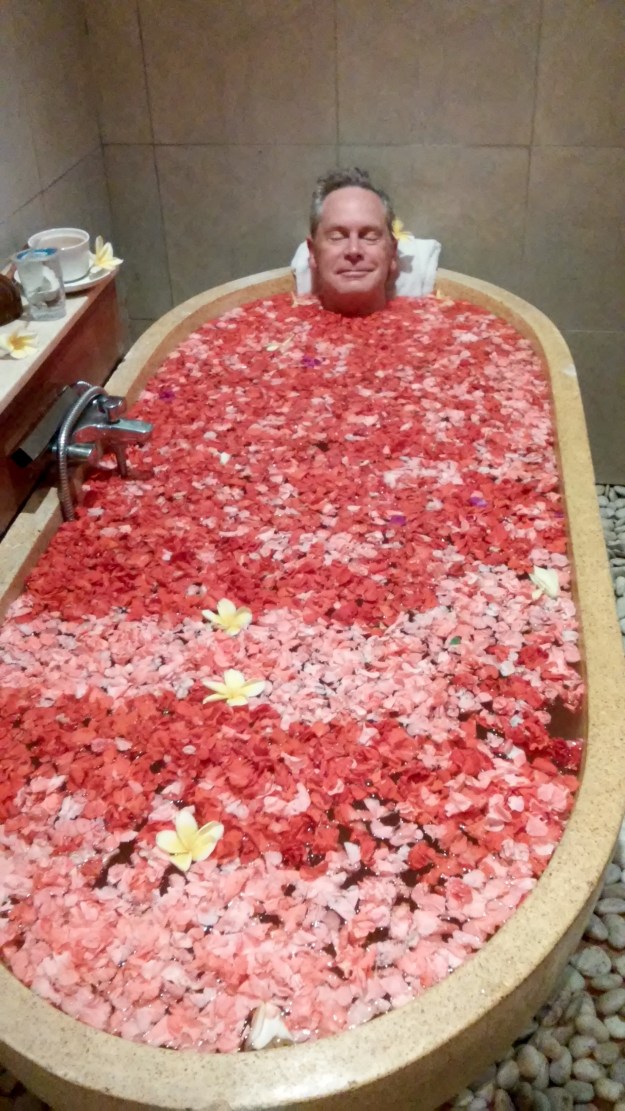
img_1363

I think I forgot to show you the photos of the pool from our balcony, so here you go. I have to say, it is most imaginatively done, with a beach with real sand which extends for half the length of the pool. I have no idea how it doesn’t clog up the filter. The only downside is the water is possibly too warm (‘oh, please, John, enough!!’ I hear you cry). It is decidedly warmer and more humid here in Bali at between 30 and 33 degrees, which means that we have about 4 showers a day at least. No rain to speak of, though it is supposed to be wet.

We have been out and about. We booked a car and driver for the day and headed north. Actually, we headed south first along the street on which our hotel is located, Jalan Sunset, jalan meaning street, so as to avoid the traffic of Denpasar and pick up Jalan By-Pass, as it is called here, to get to our first appointment which was a display of Balinese Barong dance and what I suppose must be called theatre. We arrived a little late, but there was still much to get our teeth into. The Barong is a mythical beast, half pantomime horse and half lion, though it can also be a tiger, boar or pig. The Barong, usually accompanied by a mischievous monkey, is the guardian of good against the widow witch, Rangda, who represents evil. The whole spectacle did remind me a pantomime Balinese style or possibly Gilbert and Sullivan as there were some splendidly dressed older characters who ran around rather ineffectually trying protect the maiden from various other elderly gentlemen, who appeared to be villains of one sort or another, all done in an over-the-top manner. There is also a touch of comedy, not least when a dog appears and is knocked unconscious, or so they think, and then seems to be decidedly less dead as evidenced in the photo below – but all is well, that was just his tail sticking up between his legs! All this is accompanied by full gamelan orchestra of plink-plonk music and crashing cymbals and drums. Great costumes!

We were now heading north through the town of Ubud, though it is very much ribbon development in much of central Bali and sometimes hard to tell where one district starts and ends. Ubud is the art centre of Bali, with chic galleries, stonemasons and wood carvings on an almost industrial scale, not to mention jewellery and clothes shops and the usual tacky tourist stuff. It is actually really enticing, especially if you are looking to set up home or a hotel. Some of the pieces are superb, massive statues or huge carved tree roots. We visited a silver shop, an art gallery, which had some good examples of the unique styles of Balinese painting with some pretty staggering price tags attached and a stonemasons. Now the last proved too tempting and there should be a crate arriving at home in a couple of months with a few pieces for the garden. The works themselves are ridiculously cheap, though the shipping hits you a bit, but we couldn’t resist.

Our driver, Yasa, organised for us to visit a family compound. Bali society, despite a very high level of tourism, still seems very traditional especially when driving north where the roadside has walled compounds joining onto one another. Each compound contains an extended family, the compound and village oriented ‘kaja-kelod’ which is towards Gunung Agung (Mount Agung) and away from it. The mountain is considered the home of the gods. Each family member usually has their own building in the compound with shared facilities with the different structures representing different parts of the body. So the family shrine is the head, the courtyard the navel, the ‘bale’ or raised thatched platforms used for different functions, the arms, the kitchen and rice barn the legs and feet and the rubbish tip located alongside the pig pen, the anus. The one we visited was not that wealthy, but seemed to be well kept. The bell-shaped bamboo like things contain chickens and sometimes fighting cocks (big in Bali). The things that look like posts with a thatch on top are the different shrines of the family. By the way, when building a new compound, much is made of auspicious days to build and measurements are taken of the head of the household and the layout is calculated relative to those.

The smallest organisational unit is the banjar or neighbourhood and each adult male is a member when they marry, with about 50 to 100 being the usual size, though they can be as many as 500. The banjar is effectively the parish council and makes many important decisions on a wide range of issues. And then there is the very important subak, the organisation that controls the sawah or rice fields, made up of farmers who use the water to irrigate their plots, very important to avoid disputes.

Well, a brief insight into Balinese life. Religion, Hinduism, is a very important part of every day life, but I will cover that in the next blog.

We pushed on to see some rice terraces, which have now become a tourist attraction to the extent you have to pay to see them, the money going to help the local community, which is fair enough. I have thrown in a few other rice-related pics as well…

And on we went to reach the furthest north we were going to go, a view of Gunung Badur, a still-active volcano, that last erupted in 2000 and is still smoking now, which is a good sign according to the locals as it means it is letting off steam. Lovely views, especially of the accompanying lake. All very atmospheric, all the more so as there were scudding clouds sweeping in every now and then.

The whole area is quite high up, naturally, and so a good place for market gardening which meant Val could get her fix of durian! Eaten outside the car, I might add. The other fruits highlighted below are mangosteens and rambutans.

Next on the itinerary was a temple or pura called Gunung Kawi Sebatu where there are ritual bathing pools, very important in Balinese religious customs as they are used to cleanse ‘sebel’ or ritual uncleanliness. This could be when women have their period, someone has a serious illness or for a family, after the death of a relative or for a village after, say, a plague of rats in the rice fields. In 2002 after the bombing in which over 200 died, the whole island went through exorcisms of ritual cleansing. I cannot emphasise enough how important all of these rituals are on a daily basis with offerings made to little shrines everywhere, including outside the lift on the top floor of our hotel! They are partly to ward of demons too. I will try to cover that in a later post. Fascinating stuff. Anyway, pictures of the temple. I nearly got lost in the maze of stalls that you had to negotiate on exit selling a huge array of trinkets and quite a bit of tat, including, oddly, wooden penises. No idea why or who is buying them!

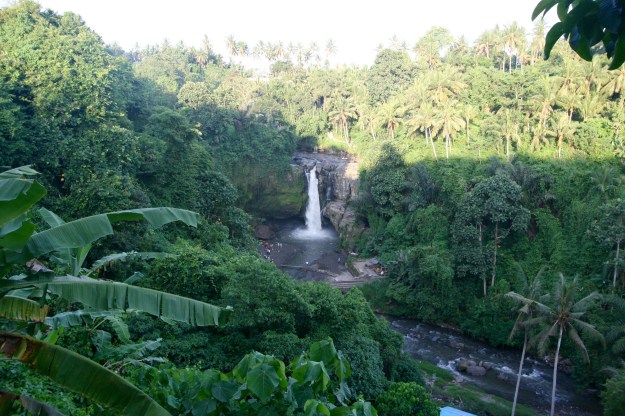
We just had time to have a quick look at a local waterfall before heading back into the even heavier traffic nearer to the hotel.
img_4339

All in all a fascinating day out and a good taster of what makes Bali tick. It would have been great to have been able to explore the island in greater detail, but getting about either involves hiring a car or motor scooter (you can just picture Val and me doing the latter!), which involves negotiating the traffic or getting someone else to drive us. It is a surprisingly big island when you are stuck in traffic a lot of the time. Still we did make another expedition on which more soon.

Well, that was a big post. I will try and start another one soon!