1st February, 2017
Our very young looking guide Banh (which he pronounced Ben, possibly to make it easier for us) picked us up from our hotel with the weather looking very doubtful and so, armed with our hotel umbrellas, we set off for the sights of Hue. It was the capital of Vietnam from 1802 to 1945, home of the Nguyen dynasty and it still has a rather regal air, mixed with a good dose of French colonialism. It still sees itself as a bit superior to the rest of the country not least in terms of poetry, art and learning. It still has considerable remains of its walled Citadel and Imperial City as well as several royal mausoleums and charming garden houses, of which more shortly.
The rain did not deter us and we set of for our first destination, the Thien Mu Pagoda, a seven-storey affair built in 1601. It was very impressive and so different from all the pagodas we have seen in Thailand and Myanmar. The stele is lovely too, perched on the traditional tortoise and recording the history of Buddhism.


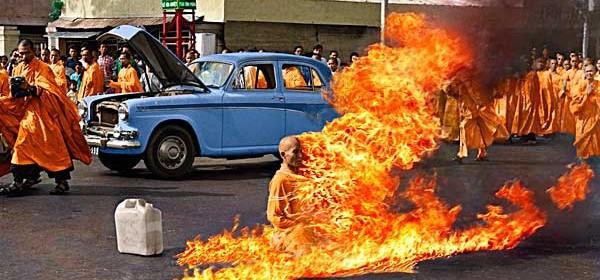
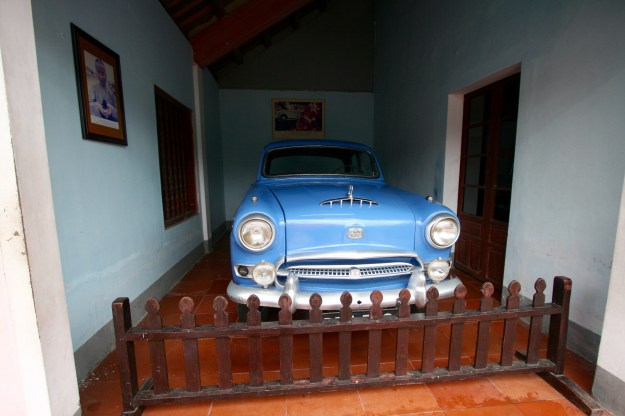
The monastery attached to the pagoda became a centre of opposition in the 1930’s and 1940’s, but it became instantly famous in 1963 when one of its monks, Thich Quang Duc drove his blue Austin car down to Saigon to protest against President Diem’s treatment of Buddhists in what was then South Vietnam. Early in the morning of 11 June, 1963, he and a column of other monks left the Xa Loi Pagoda and processed to the intersection of Cach Mang Thang Tam and Nguyen Dinh Chieu. He then sat and meditated as fellow monks doused him with petrol and then set light to him in protest at the repression of Bhuddists by South Vietnam President Diem. This event was famously caught on camera and flashed across the world. After more self-immolations, arrests and killings and after more mass protests, Diem and his brother were eventually assassinated on 2nd November, 1963. The car is still there on display with a picture of the event in the background.
I think I mentioned the lovely gardens here in Vietnam. They really do them well, both in the temples and in public places. This temple was no exception with some perfectly gorgeous bonsai trees. Wet, but still stunning (just like Val, posing next to one or two!). One had a mean-looking caterpillar on it, very poisonous according to Banh.


Just down the road we were taken to what was in fact one of the highlights of the tour, a garden house. This is the Tha Om garden house built by the grandfather of the current 63-year-old owner. His grandfather was a mandarin and it was the fashion for them to build lovely houses outside the city surrounded by lush gardens and water. The current house was all but destroyed during the wars, but has been lovingly restored by our host to at least 30% of its former glory. It is in fact a series of houses linked by walkways each serving a different task such as sleeping, cooking, dining and to house the many wives that was the fashion at the time. The current incumbent could not have been more charming with a great smile and ready laugh. He was an architect so perhaps he had a natural love for the historic home of his ancestors, but he must have spent a lot on its restoration which has been done to a very high standard. My only regret was that I had left Val’s camera, which is better for interiors, in the car.


He was the sort of person you felt you could talk to for ages, but sadly we had a schedule to keep to, so after some lovely refreshments, we set off in the rain. It was a rather strange interlude as our car seemed to have disappeared or so we eventually discovered, so we did not think it odd at first when Banh suggested we walk up the road back towards the pagoda. We presumed that the car would appear, but no sign of it as we trudged along, umbrellas working overtime. As the car had Val’s medication in it, Banh was eventually persuaded to hail a taxi that took us back to the hotel to get some reserve meds. All a bit odd, but not unheard of and we did eventually meet up with our belongings in due course. Sadly it meant we could not take our trip down the Perfume River, though as it was still pouring down, that was probably not a great loss. Banh was mortified, but it was not a problem. He was a very sincere young man of about 24 going on 65, who spoke so clearly and precisely in English with a gap between each word and slightly odd accent that he did tend to sound a bit like Stephen Hawking, which image, now firmly entrenched in my mind, was very hard to shift for the rest of the trip! He had lots of knowledge, though and was happy to intersperse this with some rather adult opinions on many different topics.
A brief stop at the hotel to top up with medication and then it was off again into the rain for a brief drive to where the royal mausoleums are. The Nyugen dynasty liked to build themselves some impressive resting places and there are 7 you can view though time meant we could only get one in, that belonging to Khai Dinh, who ruled from 1916 to 1925, very much a French puppet who liked French style and architecture. He only reigned for 9 years but it took 11 to complete his mausoleum and at considerable cost to the people of the time in extra taxes.
It is on four terraces linked by 130 steps in a beautiful setting on a wooded hillside – unfortunately not helped by the rain! Before the first terrace is the salutation courtyard where statues of mandarins stand, then on to the stele house. At the top is the principal temple, a very lavish affair, but strangely not that garish. Anyway, I will let you be the judge of that!


We then had a simple, but excellent lunch at a convent, which was a bit different. This was followed by a drive to the Hue Citadel, the area that covers some 5.2 square kilometres and has within it three concentric enclosures. Within the outer wall lies the Imperial City, the administrative centre and, further in, you get the royal palaces of the Forbidden Purple City. Unfortunately many buildings were destroyed in a fire in 1947 and then the wars took their toll as well as floods, typhoons and termites, but there is still much to see. The perimeter walls are 10 kilometres long, pierced by 10 gates. Those buildings that are still there, and there are still quite a few, exude a profusion of red lacquer and gold leaf. It must have all been awe-inspiring in its day.
Once through the outer wall there is a parade ground, a second moat and defensive wall defending the Imperial City, which follows the same symmetrical layout as Beijing’s Forbidden City. Sadly many buildings suffered from neglect even before the Tet Offensive of 1963, so there are only 20 out of the original 148 still standing. You enter through the Ngo Mon Gate, where the last Nguyen emperor, Bao Dai, abdicated in 1945, handing over the symbols of office, including a solid gold seal weighing 10 kilos! I have included a photo of a map of the area.


You walk on to the Thai Hoa Palace aka the Palace of Supreme Harmony, first constructed in 1805, though the current building dates from 1833. There are 80 ironwood pillars inside which all needed to be replaced during the restoration starting in 1991, each column weighing 2 tonnes and replaced manually and then painted with 12 layers of lacquer each one taking one month to dry. Please don’t pick me up by pointing out that actually there are a few pictures of other buildings – I was getting a bit lost on which was which by the end!


Finally we walked about the site trying to imagine what it could have been like, not least without the poncho-clad tourists.


Our last two stops were to see incense sticks and the iconic conical hats being made and a visit to the market, though the latter was a rather sorry affair, maybe due to the rain…


Well, another full day in Hue! Wet, but fascinating.
2nd February, 2017
We had a rest day, doing little, having (yet another) spa and reading, playing Yahtzee and generally relaxing. Nothing to see here!
More soon from our next destination, Hoi An, one of my favourites.
 John & Val's World Travels
AB and I went to Hue also – it didn’t rain but was grey just like your day. One thing I do remember was the drive through the streets of Hue to get to the citadel; I was saddened by the evident poverty of the people and their living conditions, especially in contrast to the pristine citadel. This was Jan/Feb 2001. Is it still so poor?
LikeLike
I don’t think either Val and I feel that the country seems poor. Very busy and entrepreneurial and lots of bustle and decidedly not a communist state! Indeed with no free education or health services, it is not even particularly socialist. Capitalism is alive and well, but with a Chinese model of a one party state and controlled media and clamp downs on criticism. The latter may prove more difficult with social media. The corruption apparently is pretty rife, so it may be in the interests of the regime to hang on for as long as possible. Lots of North Vietnamese propaganda, not always appreciated by some in the south.
LikeLike