16th September, 2016
Now one of the things you have to get used to in Jerusalem is the ‘weekend’. The Jews and Muslims of course count the weekend as Friday and Saturday – but the Muslims have Friday as their holy day and the Jews have Saturday. For the Christians, it is Saturday followed by their holy day, Sunday. So today, being Friday it was a big day for the Muslims, which is largely the Palestinians in Jerusalem. This largely manifests itself in lots of calls to prayer and what feels like a mass migration through the narrow streets of the old city as everyone hurries to and from their mosque. For some this is done 5 times a day, but for many the lunchtime one is the main one, resulting in some spectacular en masse movement of humanity.
So it was into this we ventured with the aim of a spot of lunch and a walk through part of the Old City. Our taxi driver this time was less talkative but impressively quick, but he did inform us that there had been a stabbing somewhere in the Old City, probably by the Damascus Gate. Undeterred we set off as we were on the other side of the city, entering through the Jaffa Cake, sorry Gate! Map below, which I hope you can enlarge.
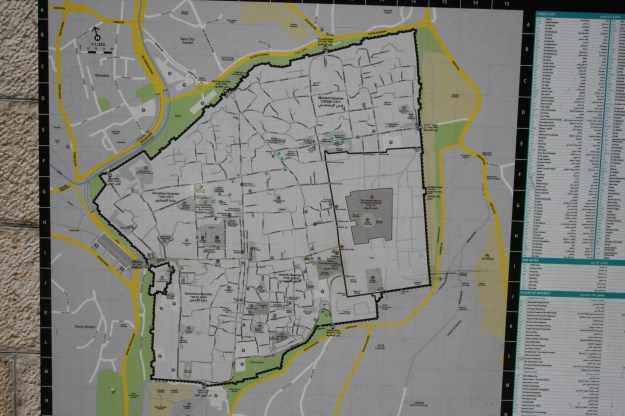
This is the biggest and busiest gate though largely because a gap was made in the wall in 1898 to allow Kaiser Wilhelm II to enter in his carriage! The original gate, next to this, was built in 1538 by Suleiman the Magnificent and is L shaped as a defensive measure. Once through you are in Omar ibn el-Khattab Square, though this is more of a widening of the road than an actual square. It is very much a focal point where you will see Ultra-Orthodox Jews, Arab sellers, Palestinians, Armenians, nuns, monks and priests all intermingled with the myriad tourists. Most of the square is owned by the Greek Orthodox Patriarchate including the impressive Imperial Hotel. Opposite is the the Citadel (Tower of David) largely built in the Middle Ages and embellished by Suleiman. Some believe this was the site where Christ was tried and condemned.


The Old City is divided into quarters with the Christians largely in the Northwest, the Armenians (also Christian) in the Southwest, the Jews in the South and the Muslims in the Northeast. I am not going to attempt to explain the current political situation in and around Jerusalem but effectively the city is divided between Israel and Palestine, but security is dominated by Israel. This also applies to bits of the Western Bank (part of Palestine along with the Gaza Strip) though the Palestine authorities do control many of the activities here. There is no border as such though there is the famous wall built by Israel to try and stop the bombings of the 1990s. You can walk though most of the Old City, though not all of the Haram Esh-Sharif, where the Dome of the Rock sits. I hope that helps, but I suggest you read further in Wikipedia!
We set off through the Souk (Shuk in Hebrew, but this largely populated by Palestinians (Muslim and Christian)), down David Street until it meets the Via Dolorosa. David Street is fairly touristy, though much of the Souk is used by the locals for everyday shopping. It still feels as though you have stepped back in time by about 2000 years in some cases and it is not hard to imagine what it must have been like, though there is more electricity these days! The history is all around you leaping from the stones. I hope the photos give you some impression of it….


We arrived at our intended lunch venue, a restaurant opposite the Austrian Hospice where the road/alley splits north and east and where a great number of people were going to or returning from the midday prayers, so there was something of a battle to get there. On arrival, the road was blocked by Israeli security forces, very and I mean VERY heavily armed who were stopping everyone from going on to the Damascus Gate due to what is reported to have been a shooting by an Israeli soldier of a man armed with knives (the stabbing incident mentioned by our taxi driver). This made our lunch decidedly more exiting as the crowd were none too happy to have their way blocked, though the vast majority seemed resigned to the problem. Claire issued us with our escape plan, ‘in the event’ and we tucked in to our pitta bread whilst the old and infirm grabbed chairs from the restaurant to sit down and the restaurant owner tried to get them to give them back.
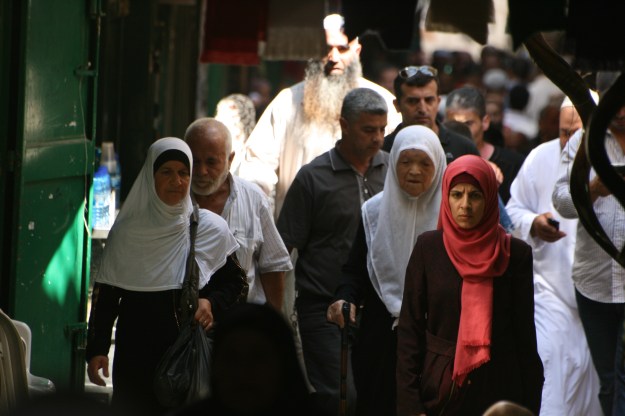

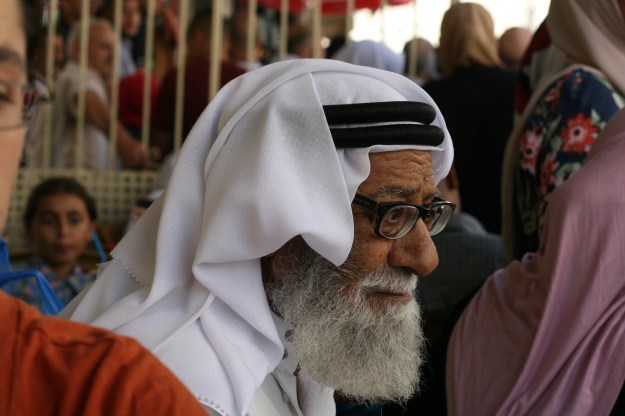
Eventually the way was reopened and everything calmed down, including Claire, we finished our lunch and set off to visit Hashim who owns an Aladin’s Cave of an antiques shop and who Claire befriended some time ago and from whom we bought our triptych icon on our last visit. Hashim is one of the most charming men you will ever meet, very useful in his line of work, but a delight to sit and chat to. Despite his quiet and friendly persuasion we managed to leave empty handed, but fortified by tea. A few random photos….


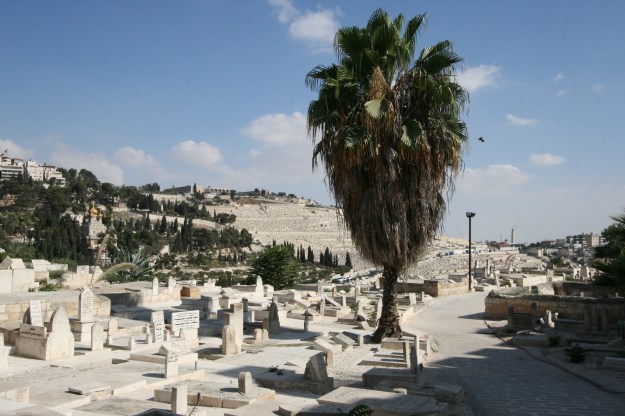
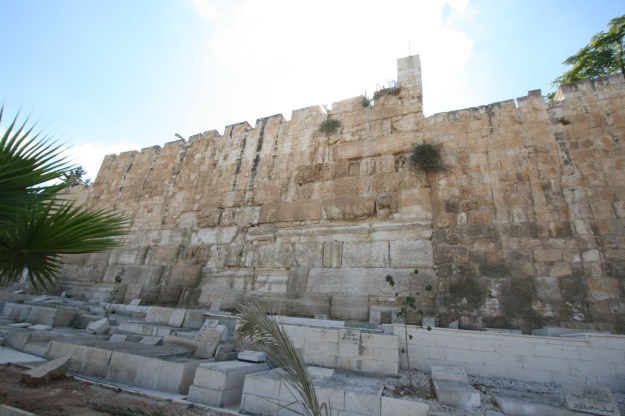
We we were heading for the Lion’s Gate in the eastern wall, also built by Suleiman though it is also known by its Arabic name of Bab Sitti Maryam (Gate of the Virgin Mary) as her supposed birthplace and tomb are nearby. First though we had a look beyond the wall at the Muslim cemetery and over the valley to the Mount of Olives (in the distance behind the palm tree in the middle photo below) where thousands of Jewish graves are as well as a Christian cemetery too. The idea is that if you are buried near the eastern wall you are going to be well placed when the Messiah comes as he is due to enter through the Golden Gate – though this may be a bit tricky as it was walled up in 16th Century and is currently out of bounds. Hope springs eternal.

We then retraced our steps and entered St Anne’s Church, a superb Crusader church built between 1131 and 1138. It is traditionally believed to stand where Anne and Joachim, the parents of the Virgin Mary lived. The acoustics are stunning and we luckily had a group of singing Japanese testing them out as we entered. Very moving. The church is next to what is thought to be the Pool of Bethesda where Christ is said to have cured a man of 38 years of paralysis. It is certainly the site of huge cisterns dating back to the 8th Century BC together with all the developments that took place since, much now in ruins.


It was was then time to head home, with a lovely evening light shining, though not before we went up onto the rooftops of the Souk, a popular walkway to avoid the crowds and where you get good views of the city and where you can pick up a beer at the Lutheran Hostel overlooking the Dome of the Rock.
Well done for getting this far – assuming you have!


 John & Val's World Travels
Really fascinating, John. Great photos too! Thanks
LikeLike